ST is in joint venture with Lockheed Martin to
develope MULE-
MOU signed in 2004,model or prototype displayed in
2006.Demonstration in 2008 Airshow?

The
2.5 tons Mule
vehicle is being developed by Lockheed Martin
and
ST
Kinetices
Followings taken in AA 2006
Spec
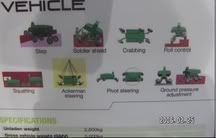
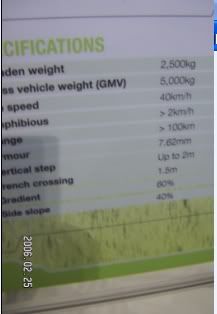
loading 2500kg---to be verified.
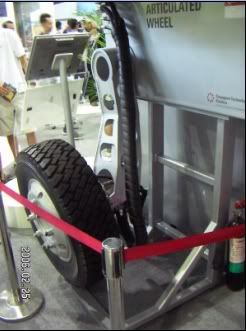
Diameter of wheels about 90 cm.
note the ST logo and the SG National flag.
2.pl share more news here.
http://www.nationaldefensemagazine.org/issues/2004/Jul/Singapore.htm
3.fresh fr oven ,in 2004.
July 2004
Singapore Company Toys With Concepts of the Future
by Roxana Tiron
While the U.S. Army is pegging its future on the ambitious
future combat systems—a family of manned and unmanned vehicles and
aircraft—a partly government-owned Singaporean company also is
looking at a series of concepts to deploy faster and lighter
forces.
Singapore Technologies Kinetics made headlines during this
year’s Asian Aerospace show for signing a memorandum of understanding with
Lockheed Martin to work on the development of the Mule, a 2.5-ton
vehicle meant for reconnaissance or transport missions under the
FCS architecture. Lockheed Martin works as a sub-contractor
to the lead systems integrator team of Boeing and SAIC.
ST Kinetics, is the land systems arm of the Singapore
Technologies conglomerate that is made up of a series of other
companies working in the aerospace, electronics and marine
sectors.
Many of the concepts that the company is working on are
based on the philosophy that the
answer to making forces lighter and more easily deployable is the
development of technologies that can be linked together.
One of ST Kinetics’ recent developments is a light strike
vehicle, called the Spider. The Spider is a line-of-sight,
semi-autonomous vehicle, which can be used both as a troop carrier
and as a robot to detect ordinance or hidden enemies.
“Imagine a situation where the crew of a Spider comes to a
bridge, for example, and then they suspect that somebody is hiding
under it,” Patrick Choy, head of marketing, told National Defense.
“The soldiers can get out and then
operate the vehicle by remote control.”
The vehicle can fit six people and has a collapsible roll cage
frame that allows the vehicles to be stacked in C-130 cargo
aircraft. According to the company, six Spiders can fit into one
C-130.
When switching to the robotic controls, the vehicle has a range
of 500 meters, “enough to keep you out of a blast area,” Choy said.
In the future, the vehicle will be outfitted with a global
positioning system to become fully autonomous, said Choy.
The Spider is propelled by a 130-horse power engine and can
handle rugged conditions, said the company. The Spider is built out
of tubes, an approach that makes the vehicle light, said Choy.
Because it is light, the vehicle also can be dropped into the field
from helicopters, he added.
“What we are also doing, is putting a protection suite around
the vehicle,” said Choy. The suite can be applied without adding
significant weight to the vehicle, or sacrificing its payload, Choy
pointed out. “Today, composite materials are so good, I can put
protection around the cabin and protection beneath it to take the
blast,” he added. The armor would
only offer protection against small arms firing up to 7.62 mm
rounds.
The Spider also can be used as a decoy in certain operations,
said Choy, fooling enemy forces into thinking the vehicle is
occupied, while it’s, in fact, remotely controlled.
To enhance survivability and reduce deployment time, the company
has developed a concept for linking robots to manned vehicles. The
technology that allows that to happen is called articulation, which
allows parts of a vehicle, or two vehicles to attach and detach
quickly. In the concept developed by ST Kinetics, the rear cabin,
when detached, can be used as a semi-autonomous robot.
“Articulation gives us a way to compensate when we
forward-deploy the forces,” Choy said. “I can send the vehicle in
two parts into the battlefield, and link them up.” The goal behind
articulation is to have platforms transported into pieces onto
C-130s or vertical take-off and landing aircraft, such as the V-22
Osprey.
Articulation is not a Singaporean innovation—it comes from
countries such as Norway, Sweden and Finland, which have to brave
snow and mountainous terrain. Choy noted that the company’s
idea of articulation was based on a
Russian variation.
People may think articulation looks “clumsy,” but he argues that
articulated vehicles have fairly good mobility. ST Kinetics used
its already existing all-terrain vehicle, the Bronco, to demonstrate the concept,
said Choy.
However, some problems with articulation do exist, he said. One
is that the articulated vehicle cannot be decoupled quickly enough.
Another problem is that once detached from the front part, which
contains the engine, the rear remains without power or steering
capability, Choy said.
To solve the shortcomings, ST Kinetics is trying to come up with
a concept called “active articulation,” said Choy. That kind of
articulation would allow the vehicle to be linked together or
detached quickly. However, the challenges in doing that are many,
he added.
“Both decoupled parts need to move as independent vehicles. If I
can bring my robotic ability and put it into the rear cabin, then I
have the capability of sending a platform out with the crew,” he
said.
The Spider itself can be outfitted with active articulation. If
it were made smaller, it could be flown in a Chinook, together with
a power trailer holding weapons and ammunition. Once on the ground,
the Spider and the trailer could be coupled.
The company also is working on entirely unmanned systems,
including one designed for urban combat. At the squad-level, ST
Kinetics is working on an improved remote attack vehicle,
for short I-RAV. The vehicle
is a remotely controlled robot on tracks.
“I-RAV is a proof of concept,” said Choy, and can be sent to
detect explosive ordnance, especially in urban and populated areas.
The robot carries a camera and can show the troops outside if a
room, for example, “is friendly or hostile,” he said.
Another piece of equipment designed for urban warfare is
the dual-caliber squad support
weapon. While the idea of a dual caliber is not new, the squad
weapon has a fire control system that allows it to shoot 40 mm
air-bursting munition from a handheld system.
With a full load of 40 mm or 5.7 mm rounds—for individual
defense—the squad weapon weighs six kilograms, light enough for
soldiers to carry, said the company. The weapon can engage targets
at ranges of up to 200 meters, according to the company.
“The squad support weapon allows us to bring an air-bursting
capability, which today is only available on crew-served weapons,”
said Choy. “I want to bring that into the hands of the individual
soldier. If you dominate rooftops, you have good control.”
