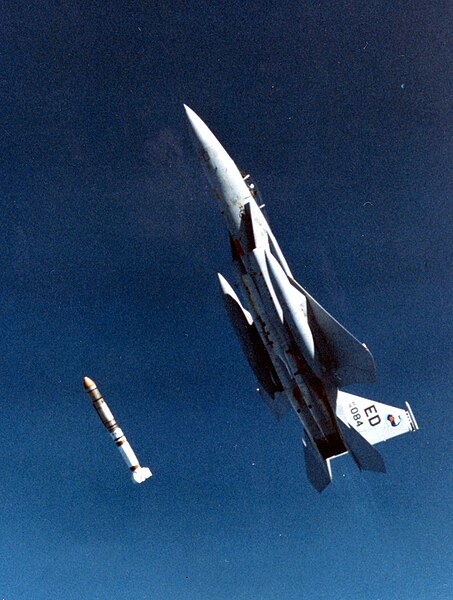
US jet intercepts ballistic missile for first time:
officials
A US F-16 fighter used an air-to-air missile to destroy a sounding
rocket in its boost phase for the first time this week in a test of
a new missile defense concept, US spokesmen said Tuesday.
The system -- named the Net-Centric Airborne Defense
Element (NCDE) -- breaks new ground in that it would arm fighter
aircraft or drones with missiles fast enough to intercept a
ballistic missile as it lifts into space.
The aircraft would have to get to within a 100 miles of the launch
site to catch the ascending missile in the first two to three
minutes after launch.
But it could be very useful in a short range combat situation
against short and medium range missiles, said Rick Lehner, a
spokesman for the US Missile Defense Agency.
The Pentagon has two other better known boost phase intercept
systems under development -- the Airborne Laser and the Kinetic
Energy Interceptor -- but those are still years away from being
ready, he said.
"So it does give us an initial boost phase capability even though
it is a much shorter range missile, and you have to be in the area
of the missile launch to be effective," Lehner said.
The test Monday at White Sands Missile Range in New Mexico
involved an F-16 fighter that fired two modified AIM-9X missile at
an Orion sounding or research rocket.
The first destroyed the rocket and the second recorded the
interception, the Pentagon's missile defense agency said.
The missile seekers' relayed images of the rocket at close range,
demonstrating the capability to acquire and track the target, the
Pentagon's missile defense agency said.
"Although not unexpected, the subsequent intercept destroyed the
target," it said.
"A second AIM-9X launched during the test observed through its
seeker the intercept of the target by the first and was also on a
trajectory to intercept the target," the agency said.
Besides special seekers, AIM-9X and AIM-20 AAMRAM are fitted with a
new liquid propellant second stage to give it the burst of speed
needed to catch a ballistic missile in its boost phase.
Lehner said the missiles were heavily instrumented during the test,
but otherwise conditions were "pretty realistic."
Raytheon Missile Systems, which developed the NCADE, said it
"provides a revolutionary, low-cost approach to interceptor
development and acquisition."
http://www.breitbart.com/article.php...ow_article=
1
Our RSAF is already operating F-16s and armed with similar
missiles. We are also facing the potential MLRS attacks and the
proliferation of ballistic missiles, therefore this Net-Centric
Airborne Defense Element (NCDE) may be suitable for our use.
When this technology matures, we can modify our F-16 to fire these
modified AIM-9X and AIM-20 AAMRAM missiles.