Paris Air Show Displays Future Technologies: Many
New Technologies Reach for Stars, but Some Will Make It
By Victor Godinez, The Dallas Morning News
Jun. 23--PARIS -- Many of the fanciful technologies and programs
unveiled at the Paris Air Show this week won't survive their first
contact with the real world of budget cuts and customer
demand.
But if history is any guide, at least a handful of the most
outlandish technologies on display at the air show these past
several days -- from suborbital passenger space flights to unmanned
helicopters -- will eventually become as mundane as in-flight
movies.
European Aeronautic Defence and Space Co., the parent firm of
Airbus, unveiled its Astrium space jet, designed to ferry
passengers into the upper reaches of the atmosphere for an
exhilarating three minutes of weightlessness.
Each ticket will cost about $250,000, but EADS says it believes the
venture can be profitable, and the first rocket plane could take
off in 2012.
Perhaps to reinforce its commitment to the final frontier, EADS had
a full-size replica of its Ariane 5 rocket on display at the show.
The rocket, standing upright, towered over Le Bourget
airfield.
Astrium isn't the only name in space tourism, of course.
Virgin Galactic (that name might be a tad ambitious) claims it will
begin launching suborbital jaunts next year for the bargain price
of $200,000.
A little closer to the ground, dozens of interesting airplane
designs were on display, but the huge number of unmanned vehicles
was particularly striking.
Besides the now-famous Global Hawks and Predators, there were a
variety of intriguing concepts, such as Dassault Aviation's nEUROn,
a stealthy, unmanned combat plane that looks a lot like the B-2
stealth bomber.
Unmanned helicopters were also popular.
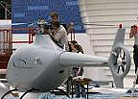
Northrop Grumman Corp.'s alien-looking MQ-8B Fire Scout was parked
on the runway and could be in use by the U.S. Navy as early as next
year to conduct surveillance and even be used as a weapons
platform.
Another funky-looking aircraft, Fort Worth-based Bell Helicopter
Textron Inc.'s V-22 tilt-rotor plane, was notably absent from Paris
this week after making a splash at the sister air show in England
last year.
That's because the plane is about to graduate from air show
curiosity to battlefield deployment, as the first squadron of 10
Ospreys heads to Iraq this fall.
"The Marines are fully engaged getting ready for the deployment,"
Marine Col. Matthew Mulhern, V-22 program manager, said during a
briefing. "It's time to start working and start making the airplane
do what it's supposed to do, which is to take Marines to the fight
and take special operators wherever they want to go."
Some other unusual items at the show this week included:
--The Versatile, Intelligent, Portable Robot (VIPeR) from Israeli
firm Elbit Systems. This backpack-size, two-wheeled bot was
patrolling a stage at the show, tracking passers-by and displaying
the video on a large screen. It may look like a toy, but the
remote-controlled machine is capable of packing a mini-Uzi and a
grenade launcher.
--The Micro Air Vehicle from Honeywell Aerospace, another
remote-controlled vehicle designed to fit in a backpack. The MAV is
designed to fly over a battlefield and spot hidden bombs using
infrared sensors. Honeywell said the U.S. military has begun using
the tiny helicopters in Iraq.
--CFM International's CFM56-7B engine, which uses biofuel made up
of 30 percent vegetable oil. In keeping with the green theme, CFM
carpeted its booth with real grass.
P A R I S A I R S H O W G A L L E R Y
2007

Bell/Agustas BA609 tiltrotor (20 June 2007)
The other one. Bell/Agustas BA609 tiltrotor made its first show
appearance.