Will Estonian
navy get CV too?
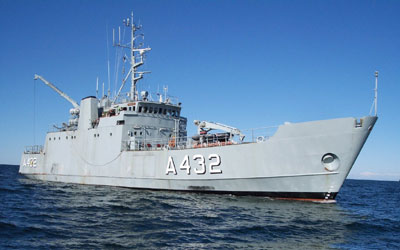
Command and Support Ship Admiral Pitka (A230)
Ex-Beskytteren
Modified Hvidbjørnen-class
Type Command and Support Ship
Built 1975, Aalborg Værft, Limjord, Denmark
Displacement ~ 1900 t
Dimensions 74,7 x 12,2 x 5,3 m
Main machinery 3 diesels B&W Alpha 7201 hp
Speed 18 knots
Complement 43 (8 officers)
Guns 1 USN 3 in (76 mm)
Radars 2 Litton Decca E, I-band
Structure strengthened for ice operations, helicopter deck
Responsibilities
The Command and Support Ship Admiral Pitka was delivered to Estonia
by Denmark on November 21st 2000, a day that Estonian Navy
celebrated its 82nd anniversary. Estonia's president Lennart Meri
was one of the honorary guests of the official ceremony. Since then
ENS Admiral Pitka has been the flagship of Estonian Navy.
The ship is a platform for the staff that conducts mine
countermeasure (MCM) operations and exercises. ENS Admiral Pitka
responsibilities also include supporting other participating units
with fuel, water, food etc. Onboard of the ship are office and
living rooms for the staff members and special facilities to
provide medical support.
The ship was built in Denmark for North Atlantic and Greenland
waters; therefore she has strengthened structure for ice
operations.
ENS Admiral Pitka has been assigned to the Baltic Mine
Countermeasures Squadron (BALTRON) as a staff and support ship for
several times which has helped to gather valuable experience in
co-operating with NATO forces.
From May 2005 to March 2006 ENS Admiral Pitka was assigned as the
Command and Support Ship of Standing NATO Response Force Mine
Countermeasures Group 1 (SNMCMG1) which is part of the NATO
Response Force (NRF) maritime capability. ENS Admiral Pitka was the
first vessel from the Baltic navies to be part of the force.
Traditions
ENS Admiral Pitka's epigraph is Pro Patria . Colours on the coat of
arms symbolize the knight's honour and make a reference to
historical ties and today's co-operation between Estonia and
Denmark. The Cross refers to Estonian Cross of Liberty and marks
Admiral Johan Pitka's important role in Estonia's fight for gaining
independence.
In February 2004 Estonian city of Rakvere and ENS Admiral Pitka
signed the friendship agreement. This agreement allows for ENS
Admiral Pitka to carry the coat of arms of Rakvere and to promote
the city in foreign harbours. The crew also participates in Rakvere
city days and has organized fundraisings for the local disabled
children's home.
Once a year the crew takes a short sea trip with their family
members onboard to show them what a life at sea is about.
Rear Admiral Johan Pitka
Rear Admiral Johan Pitka was born on 19.02.1872. He became a
merchant fleet captain on 1895 and was active in shipping business
from 1907 - 1917 in UK and Estonia.
In 1917, after revolution in Russia, when the idea of independent
Estonia turned to be realistic, he became one of the key figures in
the fight for independence.
Since 1918 he was active in establishing National Guard, sea
forces, border control and this time's secret weapons armoured
trains. He took part from the War of Independence as a Chief of
Estonian Sea Forces. On 22.04.1919 he was given Captain's (Navy)
rank and on 21.09.1919 was promoted to Rear Admiral. In January
1920 to give recognition to his activities during the War The Most
Distinguished Order of St. Michael and St. George Knight Commander
(KCMG) ordain was donated to him by HM King George V. The Estonian
government valued his contribution by the Cross of Liberty
I/1.
After the War of Independence RADM Pitka retired from the Navy and
became active in other fields of social life. He was also active in
business and agriculture.
After Soviet occupation in June 1940 he escaped to Finland and
returned to Estonia in 1944 to organize resistance against the
Soviet troops and to restore Estonian independence. Since September
1944 there is no information about him.
Rear Admiral Johan Pitka is considered to be one of the most
fundamental fighters for Estonian independence and legendary person
of Estonian history.


