Hey lionnoisy, the people in this thread have told you
repeatedly we want to talk about the tibetian army and navy...
sorry, we're just have to go with the majority in here.

Some guy related to the history of Tibet?
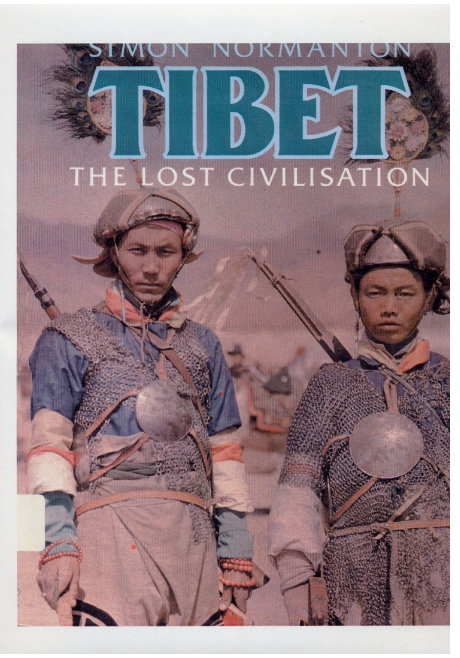

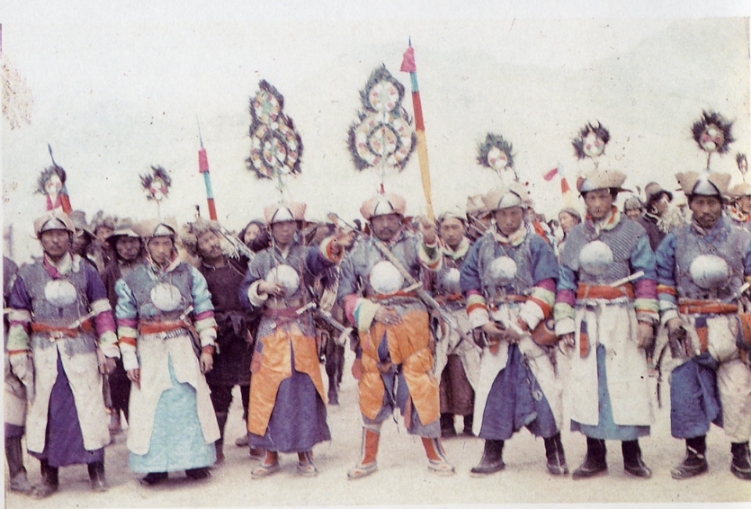
Tibetian warriors.
Invasion of Tibet
http://en.wikipedia.org/wiki/Invasion_of_Tibet
Tibet is situated between the two ancient civilizations of China
and India, but the tangled mountain ranges the Tibetan Plateau and
the towering Himalayas serve to distance it from both. The Tibetan
language is a member of the Tibeto-Burman branch of the
Sino-Tibetan language family. Tibetan history is characterized by a
special dedication to the Buddhist religion, both in the eyes of
its own people as well as for the Mongol and Manchu peoples. Tibet
is nicknamed "the roof of the world" or "the land of snows".
Tibetans are thought to have originated as a nomadic people on the
steppe. Chinese and "proto-Tibeto-Burman" may have split sometime
before 4000 BC, when the Chinese began growing millet in the Yellow
River valley while the Tibeto-Burmans remained nomads. Tibet split
from Burman around AD 500.[1][2] Racially, Tibetans can be divided
into brachycephalic, or round headed (historically peasants), and
dolichocephalic, or long headed (historically nomadic or noble).
This suggests a nomadic conquest in the distant, unrecorded
past.
Prehistoric Iron Age hill forts and burial complexes have recently
been found on the Chang Tang plateau but the remoteness of the
location is hampering archaeological research. The initial
identification of this culture is as the Zhang Zhung culture which
is described in ancient Tibetan texts and is known as the original
culture of the Bön religion.
A series of emperors ruled Tibet from the 7th to the 11th century.
At times Tibetan rule extended as far south as Bengal and as far
north as Mongolia.
The Chinese Communist government led by Mao Zedong which came to
power in October lost little time in asserting its claim to Tibet.
In 1950, the People's Liberation Army entered the Tibetan area of
Chamdo, crushing resistance from the ill-equipped Tibetan army. In
1951, Chinese representatives in Beijing presented Tibetan
representatives with a Seventeen Point Agreement which affirms
China's sovereignty over Tibet. The agreement was ratified in Lhasa
a few months later.[54]
The Chinese government at first attempt to reform Tibet's social or
religious system in Ü-Tsang. Eastern Kham and Amdo were
incorporated in the provinces of Sichuan and Qinghai respectively.
Western Kham was put under the Chamdo Military Committee. In these
areas, land reform was implemented. This involved communist
agitators designating "landlords" sometimes arbitrarily chosen
for public humiliation in "struggle sessions."
The Chinese built highways that reached first Lhasa then later to
the Indian, Nepalese and Pakistani borders. The traditional Tibetan
aristocracy and government remained in place and were subsidized by
the Chinese government. During the 1950s, however, Chinese rule
grew more oppressive with respect to the lamas, who saw that their
social and political power would eventually be broken by Communist
rule. Prior to 1959, Tibet's land was worked by serfs which
represented a majority of the Tibetans.
By the mid-1950s there was unrest in eastern Kham and Amdo, where
land reform had been implemented in full. These rebellions
eventually spread into western Kham and Ü-Tsang. In 1959 (at the
time of the Great Leap Forward in China), the Chinese authorities
treated the Dalai Lama, by now an adult, with open impiety. In some
parts of the country Chinese Communists tried to establish rural
communes, as was happening in the whole of China. These events
triggered riots in Lhasa, and then a full-scale rebellion
occurred.
The Tibetan resistance movement began with isolated resistance to
PRC control in the late 1950s. Initially there was considerable
success and with CIA support and aid much of southern Tibet fell
into rebel hands, but in 1959 with the occupation of Lhasa
resistance forces withdrew into Nepal. Operations continued from
the semi-independent Kingdom of Mustang with a force of 2000
rebels, many of them trained at Camp Hale near Leadville, Colorado,
USA. In 1969, on the eve of Kissinger's overtures to China, support
was withdrawn and the Nepalese government dismantled the operation.
See [10].
The rebellion in Lhasa was soon crushed, and the Dalai Lama fled to
India, although resistance continued in other parts of the country
for several years. Although he remained a virtual prisoner, the
Chinese set the Panchen Lama as a figurehead in Lhasa, claiming
that he headed the legitimate Government of Tibet in the absence of
the Dalai Lama, the traditional head of the Tibetan government. In
1965, the area that had been under the control of the Dalai Lama's
government from the 1910s to 1959 (Ü-Tsang and western Kham) was
set up as an autonomous region, the Tibet Autonomous Region or TAR.
Autonomy provided that head of government would be an ethnic
Tibetan; however, de facto power in the TAR is held by the general
secretary of the Communist Party, who, as of 2006, has always been
a Han Chinese from outside of Tibet. The role of ethnic Tibetans in
the higher levels of the TAR Communist Party remains somewhat
limited, despite the success of Tibetan cadres such as Raidi and
Pasang.
So Tibet actually had an army...