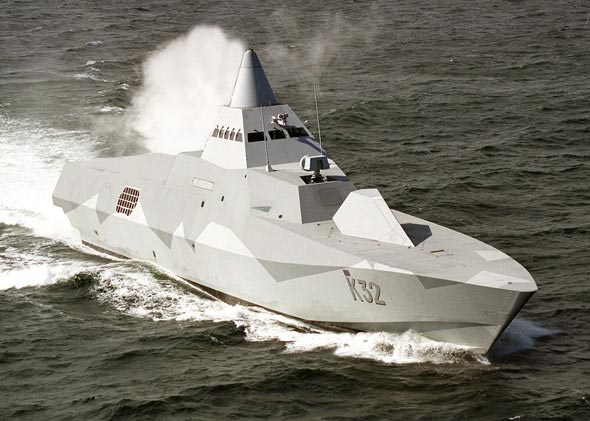
Visby - the total stealth concept
Stealth technology is revolutionising naval tactics throughout the
world and signifies a major technical advance. Having rewritten the
rulebook on air warfare, the stealth concept is now changing the
naval seascape too. A new naval era has been launched.
The decision to invest in this new technology was taken by the
Swedish Government as early as October 12, 1995. One of the key
issues addressed at that time was the need to halt the spiralling
costs of defence spending, while continuing to invest in the
future, to achieve multimission capability at a relatively low
cost.
The Visby-class corvette is the first naval vessel to feature fully
developed stealth technology. She is being built in carbon fibre
and will be very difficult to detect with radar. In all, five
vessels are on order at Kockums with an option on vessel number
six. The Swedish Defence Materiel Administration (FMV), which has
ordered the vessels on behalf of the Swedish Navy, has been
involved in the technical development and planning of the
project.
Visby is a victory for what has become known as the "Swedish
Model". The development of the new concept is the result of close
collaboration between Kockums, FMV and the Swedish Navy. The
concept that now has been realised is founded on seven year´s
experience with the "Smyge" prototype and technology demonstrator,
and is therefor well proven and tested. Sweden´s experts in the
field of stealth technology, including research scientits from
Sweden´s internationally respected Royal Institute of Technology
(KTH) in Stockholm, have all participated in the project. Involved
in the project are also Saab, Ericsson Microwave Systems, Bofors
Defence, GDC, General Dynamics Canada and others.
Flexible surface combat vessel
The Visby-class vessels are flexible surface combat ships, which
offer excellent performance characteristics in both the high-speed
and low-speed roles. They are as effective in the mine clearance
and ASW (Anti-Submarine Warfare) roles as in the mine-laying,
surface combat, underwater defence and air defence roles. They also
possess extremely high capacity in the surveillance, combat
management and communications roles. Minimal radar and noise
signatures, good magnetic properties and high impact-resistance
significantly enhance the vessel´s active self-defence systems. The
Visby corvette is, quite simply, a completely new type of naval
vessel, featuring revolutionary technology that is eminently well
adapted to the needs of the new, modern defence force currently
being built up.
The Visby corvette is designed to keep signatures to a minimum. The
hull features large, flat surfaces and sharp edges. Anything that
is not absolutely essential on the outside of the hull or
superstructure (which is not much!) has been built into the main
body of the ship, or stays hidden under hatches. To ensure a
minimal IR-signature, the gas turbine exhaust pipes and emissions
are specially, shielded at the stern, close to the surface of the
water. The hull is entirely non-magnetic, and onboard equipment is
either demagnetised or constructed of non-magnetic materials.
Good seagoing qualities
The hull has been optimised for the best possible seagoing
qualities, combining excellent course stability with extreme
manoeuvrability. It has been specially designed for water-jet
propulsion. It became apparent at an early stage of development
that an extremely low hull weight at reasonable cost would be
decisive to the vessel´s overall performance and combat efficiency.
To satisfy these requirements without compromising on performance
specifications, the hull is of sandwich design, featuring a PVC
core with a carbon fibre/vinyl ester laminate. This combines high
strength and rigidity with low weight and good shock-resistance
characteristics.
The stealth concept comprises everything that serves to minimise
signatures ands signals, either to enhance one´s own
countermeasures and sensors or to make detection and identification
by an opponent more difficult or impossible. In the collaboration
with its owner, Germany´s HDW Group, Kockums is now engaged on the
development of a somewhat larger export version of Visby, which
will be introduced on the international market. The stealth-vessel
concept has already attracted keen interest on this market.
Common reactions to Visby
On first seeing Visby, a common reaction is a degree of scepticism
about whether she is tough enough to do the job. In fact, carbon
fibre is amazingly durable, and can take more punishment than
steel. Used in space for many years now, the material has proved to
be extremely tough. Another common reaction on seeing a picture of
Visby is "that´s not a real photo; it´s computer animation, isn´t
it? But she´s special looking because she´s designed to avoid
detection by radar, IR cameras and similar sensors. When correctly
handled, the choice of material and the way she is constructed
should make her almost invisible.
A new era of naval tactics has begun.
Together HDW and Kockums has constructed Visby Variants for
the export market.
Time to seriously consider Visby as a replacement of our Victory
class corvettes?