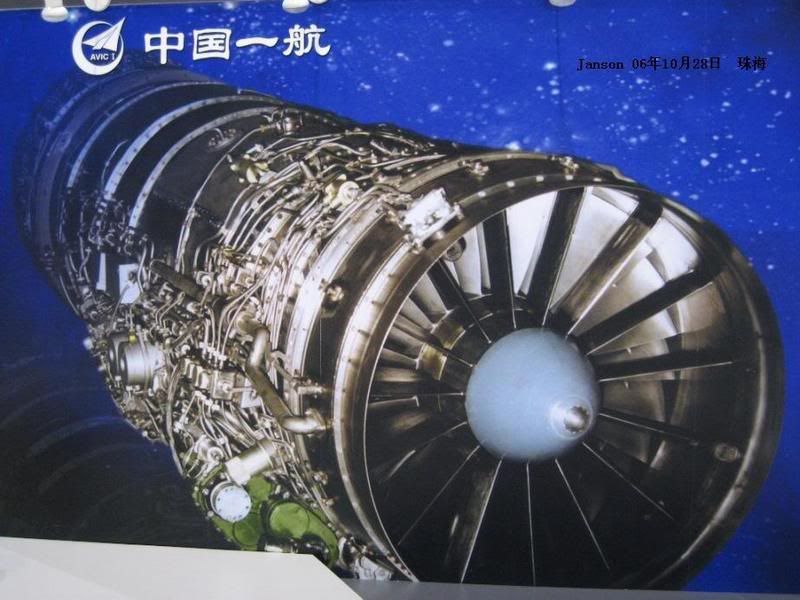
Air Show China, held here Oct. 31-Nov. 5, included the
first official detail about the Shenyang Tai Hang engine. This
turbofan powerplant is being developed for the Flanker, and is also
sometimes referred to as the WS-10A. A handful of J-11B airframes
are now likely being used for development testing, including at
least one J-11B engine-integration aircraft.
Beijing and Moscow first agreed on the Flanker sale in 1991, with a
license production contract signed in 1996. The Flanker has given
China its most capable fighter aircraft while also providing a
vehicle for its industry to gain knowledge of fourth-generation
fighter manufacturing. The first kit-built J-11A was completed in
1998. The J-11A still uses Russian engines, radar and
weaponry.
Design and development of the Tai Hang has been underway
for nearly two decades, says one senior Chinese aero-engine
executive. He admits the program has proved challenging: "We hit
difficulties in developing the engine."
Chinese industry executives attending the show remain reticent to
discuss the J-11B program. The executive would say only that the
Tai Hang has "similar applications to the Al-31 [the present Su-27
engine]. It's of a similar thrust and is of the same technology
generation." The J-11B program also includes the integration of
Chinese-developed planar array pulse-Doppler radar replacing the
Russian N-001 cassegrain radar, at least two versions of which are
fielded by the PLAAF. An image of a J-11B, still in its primer (see
top photo on p. 27), appears to show the aircraft fitted with a
different radome to the basic Su-27. Given the available space for
a flat-plate antenna, this would offer a performance improvement
over the N-0001.
Also associated with the J-11B is the Luoyang PL-12 active
radar-guided medium-range air-to-air missile. While the Chinese air
force already has the Russian R-77 (AA-12 Adder) in service with
the Su-27, the PL-12 offers a big performance increase over the
present export standard of the Vympel R-77. Officials from the
company were unable to discuss the PL-12 project.
The initial development test-firing program for the overall PL-12
program now appears complete, with the missile at least close to
service entry. It was integrated first on the J-8II for the
development program. Trials of the PL-12 on the Chengdu J-10 also
have been carried out.
The PL-12 does benefit from Russian technology, with the seeker and
inertial guidance system provided by Moscow. A variant of the Agat
9B-1103M radar seeker is the most likely candidate for the missile.
This seeker was intended initially for an improved version of the
R-77, but appears to have been sold to China first.
The PLAAF currently has the capability for two-target engagement
using the Su-27, R-77 combination. Successful integration
of the PL-12 on the J-11B would likely provide a genuine
multitarget capability and give the PLAAF a more capable air
superiority aircraft.
The country is also moving to fill gaps in its tactical weapons
capability, and to bolster its ability to support combat aircraft
export proposals with credible guided-weapons packages. The show
included the presentation of several previously unseen air-launched
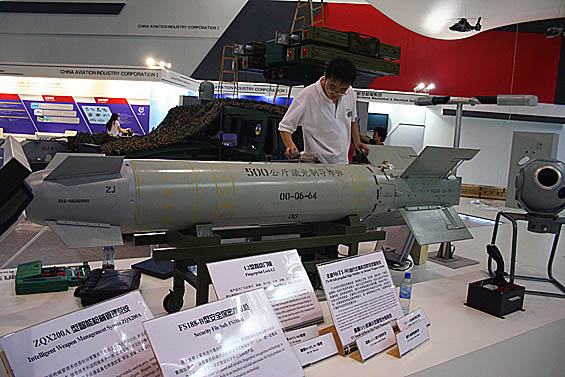
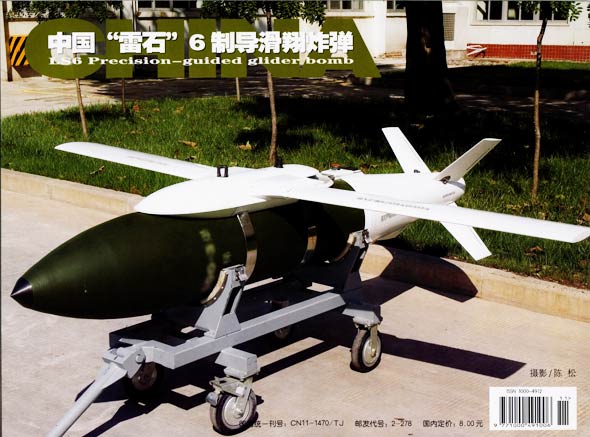
tactical systems. Luoyang showed the LT-2 laser-guided bomb, along
with the LS-6 precision-guided glide bomb (middle photo). Rival
China Aerospace and Technology Corp. unveiled its FT-1 and FT-3
satellite-guided weapons family. Both are aimed at potential
exports of the FC-1 light fighter, including Pakistan, and likely
national requirements.
Meanwhile, China Aerospace Science and Industry Corp. (Casic)
showed the C-704 antiship missile (bottom photo), along with the
C-802KD air-to-surface version of the C-802 antiship weapon.
The LT-2 has been in service with the Chinese air force "for more
than three years," says a Luoyang executive. The 500-kg.-class
(1,100-lb.) weapon resembles the Russian KAB family. The official
suggested that the laser-guided bomb has a range of up to 20 km.
(12.4 mi.) from high altitude, with an average accuracy of about 2
meters (6.5 ft.).
The LS-6 appears, in effect, a successor system, with a family of
weapons planned. The official says "about a dozen" launch tests of
the LS-6 precision bomb kit have been carried out using a Shenyang
J-8II as the test aircraft. The program was begun in 2003, with
testing now complete.
He identifies the JF-17--the Pakistan air force designation for the
Chengdu FC-1 now in development--as the next intended aircraft for
integration of the weapon. Guidance is provided by an inertial
package coupled with satellite navigation. The official says the
weapons family will be capable of using three systems--the U.S.
GPS, the Russian Glonass and China's own Beidou system. The
architecture for this system eventually foresees using five
satellites in geosynchronous orbit (GEO) and up to 30 non-GEO
platforms.
The 500-kg. LS-6 has a maximum launch range of 60 km. from medium
altitude. A 1,000-kg. kit has also been considered, although this
requires a larger wing. A 250-kg. variant is in the pipeline as
well. Also under study is the addition of a laser seeker.
The two weapons shown by Casic cover the 250-kg. and 500-kg. class.
The FT-1 bears a resemblance to the U.S. Joint Direct Attack
Munition. Development began in 2001, according to a company
executive. Tests have been carried out from a Xian JH-7. Range of
the FT-1 is given as up to 18 km., depending on the release
altitude and aircraft speed, with an accuracy of "30 meters, or
less." Casic subsidiary China National Precision Machinery Import
& Export Corp. is responsible for the C-704. At least a small
batch of the antiship missile has been produced.
The design is strongly reminiscent of the Hongdu JJ/TL-6 antiship
missile, although dimensions and performance figures for the two
vary slightly. Data provided for the C-704 give the monopulse
active-radar-guided missile a maximum engagement range of 35
km.
The company is also offering a further variant of its C-802
antiship missile. The air-launched C-802KD is claimed to be capable
of engaging ships in harbor or some fixed land targets. Given that
the missile is fitted with a radar seeker only, land targets would
need to provide a high radar contrast.
An electro-optically guided medium-size air-launched weapon in a
similar class to the C-802 is under development in China. This
program almost certainly corresponds to the KD-88
designation.
The first indications of a measured shift in Sino-Russian relations
could be detected in the outcome of the ongoing "push and shove"
between Beijing and Moscow over the provision of a Russian engine
for the FC-1 light fighter. The aircraft is a joint development
between China and Pakistan.
Chinese and Russian aerospace executives are maintaining China's
FC-1 light fighter will be provided to Pakistan with a Russian
engine, though this is still pending political approval from
Moscow. The Russian government has yet to approve the release, with
suggestions that Moscow might nix a deal to avoid jeopardizing
sales to India.