Originally posted by ndmmxiaomayi:
Studied it in social studies, but not in detailed because
it is just to show us how conflict can happen between nations of
different ideologies. It all started with Japan again. It is after
WWII, and I think these two countries were separated. After the
war, UN suggested bringing back the two countries to be one country
again, but North Korea prefers communism and South Korea prefers
democracy and this did not lead to wars. [b]Only when US and China
steps in, then the war started. [/b]
No, Russia was then one. China was only involved when the UN had
advanced near the Yalu river. China has in fact informed the UN of
it's intention if the UN reached a certain distance from the
chinese border. Because they knew Gen MacArthur had every intention
of invading china.
As I say do some research...
But be alert of details... Because while doing searches.. I came
across photos and description of NK/PLA atrocities, only to find
them false, a blantant white wash.
For example .. this photo and its series widely distributed in the
US sites ... Taejon, 9/50 South Korean Civilians murdered
by retreating PLA , A few of the tens of thousands slaughtered by
North Korea
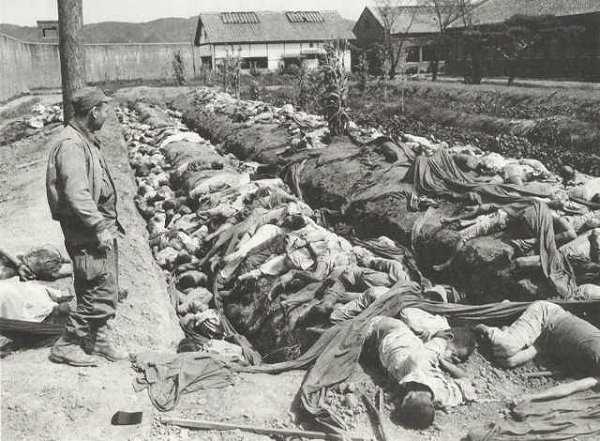
However, the date and corresponding AP reports
differently
All sides in the war were guilty of atrocities. KPA forces
executed several hundreds of American prisoners of war, albeit
usually in the traditional battlefield 'humane' manner: one bullet
behind the ear. Treatment of ROK prisoners of war was said to be
considerably worse, but there is little evidence of this. There
were a number of brutal atrocities against civilians, especially as
the occupation of the South ended.
The United Nations archive contains well-documented accounts,
verified by witnesses and relatives, of several mass murders of
Southerners by the Northern occupants, including a particularly
ghastly one at Chonju. For what it is worth, captured North
Korean documents continued to show that high-level officials warned
against executing people. Several orders to stop any further
executions were picked up on the battle-field; handwritten minutes
of a party meeting, apparently at a high level, said, 'Do not
execute the reactionaries for [their] wanton vengeance. Let legal
authorities carry out the purge plan.'
It has been alleged that the North Koreans perpetrated one of the
greatest mass killings of the war in Taejon, where between 5,000
and 7,000 people were slaughtered and placed in mass graves. Some
Americans were included; in one incident six survivors, including
two Americans, were found alive, feigning death under the light
soil thrown on top of them. Mass burial graves were reputedly also
found at many points in South Cholla, and Appleman writes that the
North Koreans 'ran amok' in Wonju on 2 October, killing between
1,000 and 2,000 civilians.
What actually happened in the Taejon atrocity is not at all
clear, however. In early August Alan Winnington published an
article in the London Daily Worker entitled 'US Belsen in Korea',
alleging that the South Korean police, under the supervision of
American advisers, had butchered 7,000 people in the village of
Yangwol, near Taejon, during the period 2-6 July. He visited the
area and found twenty eyewitnesses who said that on 2 July
truckloads of police arrived and made local people dig six pits,
each 200 yards long. Two days later political prisoners were
trucked in and executed, by bullets to the head and decapitation by
the sword, and layered on top of each other in the pits 'like
sardines'. The massacres continued for three days. The witnesses
said that US officers in two jeeps observed the killings.
/91/
North Korean sources said 4,000 had been killed (changing the total
some months later to 7,000), comprising mostly imprisoned
guerrillas from Cheju Island and the Taebaek-san area and those
detained after the Yosu-Sunchon incident. They located the site
differently, placing the events at Change village in Sanae
township, Taedok county.
The American Embassy in London called the Winnington story an
'atrocity fabrication', however, and denied its contents. British
officials in Tokyo said, 'There may be an element of truth in this
report.'
There is undeniable evidence of South Korean massacres on a lesser
scale. A New York Times reporter found an ROK policeman with forty
civilians in his retinue, alleged guerrillas, observing him as he
'crashed the butt of his rifle on the back of one after another'.
'We bang-bang in the woods,' the policeman said happily, meaning
that the prisoners would be 'taken into the groves and executed
after their backs had been broken.' An Australian witnessed a
similar incident in Kongju, where twenty civilian prisoners were
kneeling and being beaten by guards 'on [the] least movement'. On
inquiry the guards said, 'Guerrillas, bang-bang.' A Manchester
Guardian correspondent saw a truckload of sixty prisoners taken to
the Kum river on 12 July and executed by ROK authorities. 'Tiger'
Kim had fifty North Korean prisoners of war beheaded in August;
when the Red Cross made representations to KMAG about it, KMAG
officers said they 'would not like to see it get in the hands of
correspondents'.
James Cameron of London's Picture Post wrote about what he termed
'South Korean concentration camps' in Pusan in the late summer of
1950:
I had seen Belsen, but this was worse. This terrible mob of men -
convicted of nothing, un-tried, South Koreans in South Korea,
suspected of being 'unreliable'. There were hundreds of them; they
were skeletal, puppets of string, faces translucent grey, manacled
to each other with chains, cringing in the classic Oriental
attitude of subjection, the squatting foetal position, in piles of
garbage ... Around this medievally gruesome market-place were
gathered a few knots of American soldiers photographing the scene
with casual industry ... I took my indignation to the [UN]
Commission, who said very civilly: 'Most disturbing, yes; but
remember these are Asian people, with different standards of
behaviour... all very difficult.' It was supine and indefensible
compromise. I boiled, and I do not boil easily. We recorded the
situation meticulously, in words and photographs. Within the year
it nearly cost me my job, and my magazine its existence.
Picture Post never published Cameron's story, causing a
'mini-mutiny' on the magazine; shortly thereafter Picture Post
'withered away, as it deserved'.
http://www.chss.montclair.edu/english/furr/Vietnam/cumings1.html


