Chinese build a high-tech army within an army
By Robert Marquand, Staff writer of The Christian Science
Monitor
Thu Nov 17, 3:00 AM ET
BEIJING - Shi Jin wears a jean jacket, has razor-cropped hair, and
seems gravely earnest. An officer in the People's Liberation Army,
he was wooed from a Beijing vocational college three years ago by
recruiters who talked up his technical aptitude - and his
patriotism.
In the past decade, China has undergone two military high-tech
reforms designed to give the country a modern fighting force. To
sustain that progress, it must attract many more gung-ho young
engineers like Shi, who spends most of his time working on an
"informational" revolution that planners hope will one day allow
them to "see" a battlefield with the same depth as the US military.
"I will not do any direct fighting if there is a war, but I am
contributing on the technical side," he says. "We are all needed in
the new Army."
China's desire, often stated, is to be a great nation. Many in
Beijing feel that the country's natural right is to be the major
power in Asia. But China has rarely been given high marks in global
military annals. It has a "brown water" Navy that doesn't navigate
open seas. It can't project power by sending forces abroad. It has
relied on states like Russia for jet fighters, cruise missiles, and
other advanced weapons.
Yet it now appears China is methodically changing this
equation.
In a surprisingly short time, China has accomplished two feats.
One, it has focused its energy and wealth on creating an army
within an army. It has devoted huge amounts of capital to create a
small high-tech army within its old 2.2 million-member rifle and
shoe-leather force.
The specialty of this modern force, about 15 percent of the PLA, is
to conduct lightning attacks on smaller foes, using an all-out
missile attack designed to paralyze, and a modern sea and air
attack coordinated by high-tech communications. In other words,
this new modern force is designed to attack Taiwan.
Second, China has taken painful but successful steps to create a
"defense industrial base," or weapons-building capability. The PLA
has improved its factory quality control and its ability to adapt
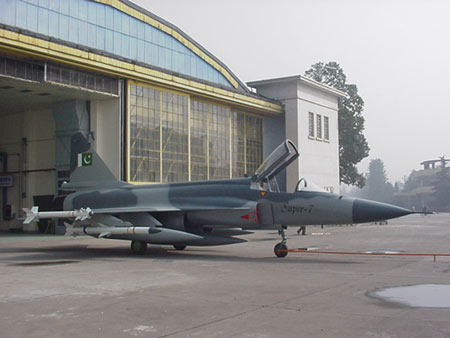
foreign technology. It is bringing an indigenous small-wing F-10
fighter off the production line, and it is moving rapidly toward a
"blue water" Navy with ships built in China.
Indeed, the past three years have yielded the impressive fruits of
a modernization campaign started in the late 1990s: A nuclear
attack submarine, the 093, launches in months; presumably it will
be capable one day of firing satellite-guided cruise missiles that
can blast a cruiser or carrier. China now has more accurate ICBMS,
a host of land- and sea-based cruise missiles, and about 400 Su-27
and Su-30 Russian fighter jets it didn't have before.
"Do the old shibboleths still apply - that the Chinese defense
industry is backward, poor, and low-quality?" asks Evan Medeiros,
an analyst with the RAND Corp. in Washington, D.C.
"No," he says. "It seems China has turned the corner.... For the
first time in 20 years, the PLA has adopted reforms that make
sense. They adopted, and implemented, and are really learning
quickly." Medeiros is lead author of a 300-page RAND study, "New
Directions for China's Defense Industry," released this
month.
"The PLA has undergone a revolution in communications," says James
Mulvenon, of the Center for Intelligence Research and Analysis in
Washington, D.C. "They have gone from dirt to wireless in a
generation."
Taking China's power seriously
Such progress is catching attention, respect, and concern in the
Pentagon. At Honolulu's US Pacific Command, and in military circles
in Taiwan, Guam, and Tokyo, it is universally accepted that China
is on its way to becoming a military challenge in Asia. US planners
no longer talk dismissively of China's power or, potentially, its
reach. In a key shift, US ability to quickly and easily defend
Taiwan in an attack is no longer a given. Chinese cruise missiles
are creating a more lethal environment in the Taiwan Straits.
This summer, Gen. Zhu Chenghu, dean of China's National
Defense University, raised the subject of weapons of mass
destruction, which China rarely mentions, in connection with
Taiwan. Should US forces aid Taiwan in a war, he told bewildered US
visitors, "Americans will have to be prepared that hundreds ... of
cities will be destroyed by Chinese" nuclear
weapons.
Coming to Taiwan's rescue "used to be a political decision," says
Denny Roy, an expert on cross-straits relations at the Asia-Pacific
Center for Security Studies (APCSS) in Honolulu. "Now it is a
political and a military decision."
Yet while China may have turned a corner, tomorrow's Monitor story
looks at how China's military prowess runs far short of the
doomsday trend lines. China's military has not "leapfrogged" into
modern warfighting in the way many alarmists in the US often loudly
suggest.
Perceptions about a "China threat" have taken several sharp turns
in the past 24 months. One came in 2004, as it appeared Beijing was
making progress on not one but three submarine programs, including
the 093. A Sovremenny class destroyer, one of four new Chinese-made
destroyers appeared out of the blue. China was laying fiber-optic
cable around the country; it was developing a capability at the
heart of high-tech warfare called C4ISR (the interlocking sets of
missile targeting and tracking known as command, control,
communications, computers, intelligence surveillance and
reconnaissance).
read the rest below
http://news.yahoo.com/s/csm/ochina