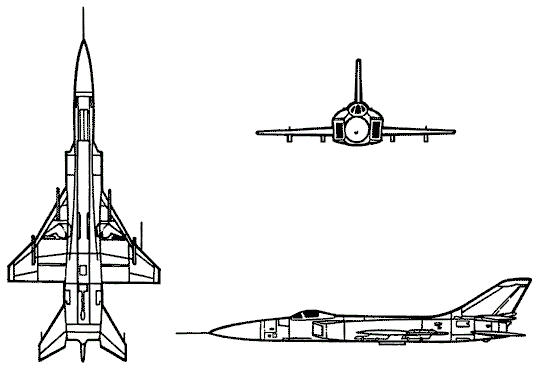
Sukhoi
Su-15
The Sukhoi Su-15 (NATO reporting name Flagon) was a twin-engined
interceptor aircraft developed by the Soviet Union in the 1960s to
replace the Sukhoi Su-11.
History
Recognizing the limitations of the earlier Su-9 and Su-11, the
Sukhoi OKB quickly began the development of a heavily revised and
more capable aircraft. A variety of development aircraft evolved,
including the T-49, which shared the fuselage of the Su-9
(including its single engine), but used cheek-mounted intakes to
leave the nose clear for a large radome for the 'Oriol-D' (Eagle)
radar, and the T-5, essentially a heavily modified Su-11 with a
widened rear fuselage containing two Tumansky R-11 engines.
These led to the T-58, which combined the twin engines with a
modified version of the T-49's nose, but with side inlets further
back, behind the cockpit. The T-58 first flew on 30 May, 1962. As
the Su-15, it entered service testing 5 August, 1963, but its
service entry was delayed by Soviet government ambivalence about
the value of manned interceptors as opposed to ballistic missiles
(directly parallel to the political controversies in Britain that
led to the cancellation of the TSR-2 and other aircraft).
Nevertheless, it was finally accepted by the V-PVO, with the first
Su-15F (NATO reporting name 'Flagon-A') entering service in
1967.
As one of the V-PVO's principal interceptors, the Su-15 was
involved in a number of incidents with foreign aircraft. One such
attack was in 1978, when Korean Air Flight 902 was attacked over
Murmansk by a PVO Su-15. Although the civilian aircraft survived
the missile hit, it subsequently crashed, killing two passengers.
In 1981 a Baku, Azerbaijan-based Su-15 rammed an Iranian Canadair
CL-44, apparently as a deliberate attack. More notorious was the
Korean Air Flight 007 incident in 1983, when a Korean Boeing 747
was shot down by a Su-15TM based on Sakhalin, killing all 246
passengers and 23 crew. Other incidents involving reconnaissance
and surveillance aircraft may have occurred, but gone
unrecorded.
Although it was produced in large numbers, the Su-15, like other
highly sensitive Soviet aircraft, was never exported to the Warsaw
Pact. Many now belong to the Georgian and Ukrainian air forces
following the collapse of the Soviet Union, although few, if any,
remain serviceable.
In Russia, the Su-15 was gradually phased out by 1993 in favour of
more advanced interceptors, including the Su-27 'Flanker' and
MiG-31 'Foxhound.'
Description
Although many components of the Su-15 were similar or identical to
the previous Su-9 and Su-11 (NATO reporting name 'Fishpot'),
including Sukhoi's characteristic rear-fuselage airbrakes, the
Su-15 abandoned the shock-cone nose intake for side-mounted intakes
feeding two powerful turbojet engines, initially the Tumansky
R-11F. The change allowed room in the nose for a powerful search
radar, initially the 'Oriol-D' (NATO 'Skip Spin'). The early Su-15F
(known as 'Flagon-A' by NATO) had pure delta wings like its
predecessor, but these were replaced on the Su-15MF ('Flagon-D') by
a new 'kinked' delta planform of increased span, with small wing
fence above each outer pylon. This was accompanied by a new tail
with greater anhedral.
Like the original Lockheed F-104 Starfighter, the 'Flagon' had
exceptional speed and rate of climb. The Su-15 was a "hot ship" in
every respect. Take-off and landing speeds were very high, and
while the controls were responsive and precise, the aircraft was
extremely unforgiving of pilot error. It was intended as a
stand-off interceptor, not an agile fighter, and did not suffer
fools gladly.
Despite its powerful radar, the 'Flagon,' like most Soviet
interceptors before the late 1980s, was heavily dependent on ground
control interception (GCI), with aircraft vectored onto targets by
ground radar stations.
Primary armament of the Su-15 was the R-8 (later R-9 air-to-air missile (AA-3 'Anab'). Early models carried two
missiles, but 'Flagon-D' and later versions could carry four. Like
most Soviet missiles, the R-98 was made in both infrared and
semi-active radar homing versions, and standard practice was to
carry the weapons in pairs to give the greatest chance of a
successful hit. Later 'Flagon-F' models often carried two R-98s and
one or two pairs of short-range R-60 (AA-8 'Aphid') missiles. The
R-23 (AA-7 'Apex') medium-range missile, shared with the MiG-23,
was also an option in place of the R-98. Late-model 'Flagons' also
sometimes carried a pair of UPK-23-250 23 mm gun pods on the
fuselage pylons, each containing a two-barrel GSh-23L cannon
(similar to that used by the MiG-21 and MiG-23).
Other variants
The first Su-15F and Su-15MF models were superseded in 1970 by the
Su-15T ('Flagon-E'), which added a new radar, the 'Taifun,'
additional internal fuel, and stronger landing gear for higher
takeoff weights. It also added two side-by-side fuselage pylons for
drop tanks or gun pods. The new radar proved to be an almost total
disaster, and in 1973 the Su-15T gave way to the Su-15TM (possibly
also known as Su-21), with a new ogival nose radome to accommodate
the heavily revised Taifun-M radar.
Other Su-15 models included:
T-58VD ('Flagon-B'): One-off prototype using three Kolesov
lift-jets in the centre fuselage to provide STOL capability. Not
mass-produced.
Su-15U and Su-15UT ('Flagon-C'): Two-seat, combat-capable trainers
based on the Su-15F and Su-15T, respectively, with a rear
instructor seat replacing a fuselage fuel tank. Instructor was
provided with a periscope to improve the miserable visibility. Both
Su-15U and Su-15UT were known as 'Flagon-C' to NATO.
Su-15UM (or Su-21U) ('Flagon-G'): Trainer version of Su-15TM.
Some reports indicate that the Su-15TM was also designated Su-21
and the Su-15UM Su-21U. It is still not entirely clear which is
correct.