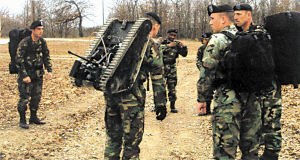
Defence engineers began developing the autonomous
unmanned ground vehicle in 1996 and came up with a prototype in
2000, said Ms Tey Hwee Choo, a programme manager with the Defence
Science and Technology Agency, which is spearheading the
project.
The new machine could be equipped to do the same job as the SAF's
Bionix infantry fighting vehicle and Bronco multi-purpose tracked
vehicle.
On top of that, it can be sent to spy on the enemy and clear mine
fields.
The engineers are also working on a system that will allow a single
operator to control a number of these robots from a distance.
Such a system will be able to screen information culled from the
battlefield and pinpoint what is vital to commanders.
Similar research is also being done by the defence industry
here.
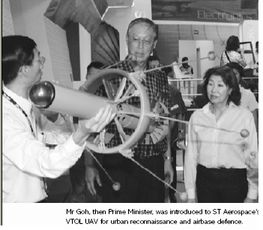
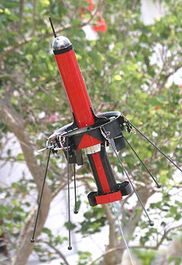
Local aircraft maintenance specialist Singapore Technologies (ST)
Aerospace began work last year on a second version of an unmanned
aerial vehicle, the Skyblade, which was developed initially by DSO
National Laboratories, Singapore's largest defence research and
development organisation.
The machine is a mini aircraft with a 1.7m wingspan and a maximum
take-off weight of 5kg. It is controlled by radio waves up to a
range of 8km.
An ST Aerospace spokesman said its electric motor can stay
undetected even if it is as close as 25m.
It is launched by hand and recovered by parachute, eliminating the
need for a runway.
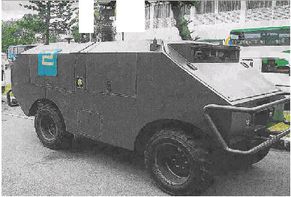
Local weapons maker ST Kinetics is also working on an unmanned
version of the Spider Light Strike Vehicle, developing the
components to enable the four-wheel drive vehicle to operate in a
semi-autonomous mode.
The unmanned version, which can travel at up to 60kmh, steered by
an operator up to 1km away, is one of about half a dozen unmanned
vehicles the company has developed in the past two years.
In about four years' time, it aims to start selling its machines to
military and commercial users, possibly equipped with cameras,
computers and communication devices more powerful, yet smaller and
more rugged than ever before.
These research efforts dovetail with the SAF's vision of
transforming itself into a 'third generation' fighting force,
exploiting technology to add items such as battle drones to its
arsenal.
An associate professor at the Institute of Defence and Strategic
Studies, Dr Bernard Loo, believes unmanned vehicles will be most
effective in urban warfare, to detect enemies in buildings.
'It means where you used to need a company of soldiers, you might
require less. So you could reduce your own casualties,' he
said.
Other unmanned projects
Air
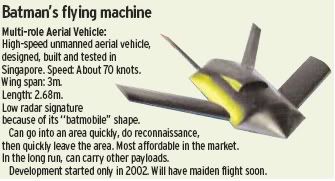
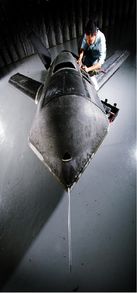
- Among the unmanned aerial vehicles being developed is Singapore
Technologies Aerospace's bat-like MAV-1, or multi-role autonomous
vehicle, which can fly into an area, reconnoitre the place, then
leave.
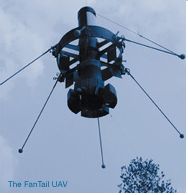
It also has the Skyblade II and the cylindrically shaped Fantail,
which can take off and land vertically, fly horizontally and
hover.
- Defence engineers have also been working on the Lalee, or low
altitude long-enduring endurance, a large aircraft that can fly
unmanned or be piloted manually.
It is designed to fly at around 18,000m, above the airways and
below satellite surveillance systems, possibly serving as an
integrated airborne surveillance and communications system, to
provide continuous coverage over a large area.
Sea
- DSO National Laboratories is testing a 2m-long underwater robot
called SEA-i designed to detect underwater mines. The machine,
which was developed over the past 2 1/2 years, runs on batteries,
can travel at 6 knots and dive 100m.
- The Republic of Singapore Navy has been developing an unmanned
surface vessel, the Spartan, with the United States Navy since
2002. The speedboat allows warships to inspect suspicious vessels
without the need for sailors to board them.
fr
http://www.dsta.gov.sg/home/DisplayPage/ContentPage10.asp?id=2506
2.What did they achieve since 2000?