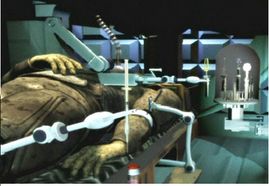
Conceptual image: Robotic surgery is performed to a injured soldier
in front line.
fr http://www.sri.com/news/imagebank/#TP
Watch the video.
Trauma Pod
MENLO PARK , Calif. March 28, 2005. Imagine an automated medical
treatment system that does not require onsite medical
personnel on the front lines of battle, and is ready to
receive, assess, and stabilize wounded soldiers during the critical
hours following injury. The Defense Advanced Research Projects
Agency (DARPA) Defense Sciences Office (DSO) has taken a
significant step toward that goal by awarding an SRI
International-led, multi-organization team a $12 million, two-year
contract to develop such a revolutionary system.
fr http://www.sri.com/news/
DARPA has more than 10 projects joint venture with Sg.
2.Team Members
* SRI International, developer of pioneering telesurgery
systems
* General Dynamics Robotic Systems, a leader in unmanned ground
vehicle systems and developer of the automated pharmacy
system
* Oak Ridge National Laboratory, a leader in weapons and material
handling robotics
* University of Texas, a research leader in software control
systems for material disposal and space manipulators
* University of Washington, a research leader in surgical
robotics
* University of Maryland, a research leader in Operating Room of
the Future
* Robotic Surgical Tech, Inc., developers of the first robotic
nurse systems for the operating room
The team held a kick-off meeting at the Medicine Meets Virtual
Reality conference in Long Beach, California on January 26-29,
2005.
fr http://www.sri.com/news/releases/03-28-05.html
The first phase of the program is an effort to develop robotic
technology to perform a totally unmanned surgical procedure within
a fixed facility. When fully developed, the Trauma Pod will not
require human medical personnel on-site to conduct the surgery, and
will be small enough to be carried by a medical ground or air
vehicle. A human surgeon will conduct all the required surgical
procedures from a remote location using a system of surgical
manipulators. The system's actions are then communicated wirelessly
to the surgery site. Automated robotic systems will provide
necessary support to the surgeon to conduct all phases of the
operation.
3.Wait 10 years more
SRI researchers caution that the project remains at least a
decade away from appearing on any battlefields. Surgeons will need
to manipulate the robot in real time, using technology that
prevents any delays between their commands and the robot's actions.
The "trauma pod" has to keep connected wirelessly without giving
away its position to the enemy, and it has to be nimble and hardy
enough to perform under fire.
fr http://abcnews.go.com/Business/wireStory?id=618826