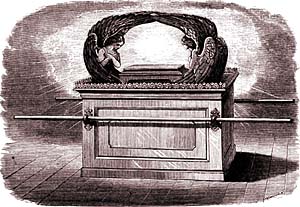
Long pondered by the community of Biblical scholarship, the rest of
the world began considering this question with the release of the
hit motion picture Raiders of the Lost Ark. Today there are no lack
of possibilities.
Based on ancient Jewish writings, some have suggested the Ark is
hidden on Mount Nebo on the Jordan River's east bank. This site is
presently in the modern nation of Jordan with no hint of the Ark's
presence.
Others suggest the Ark is hidden somewhere near the Dead Sea, on
the Jordan's west bank. This location is usually considered in
association with the ancient site of Qumran and the people of the
Dead Sea Scrolls. Here, the Ark and other artifacts are believed
buried in one of the region's caves, like the Dead Sea
Scrolls.
Another view suggests the Ark is located beneath Jerusalem, in a
stone-carved tunnel. Some say it is beneath the suggested site of
the Crucifixion, Gordon's Calvary. The Temple Institute in
Jerusalem's Old City, an Ultra-Orthodox organization dedicated to
rebuilding the Jewish Temple, says the Ark is under the temple
mount and will be revealed at the proper time - when the temple is
rebuilt.
Interestingly, the thesis of the Raiders of the Lost Ark, that the
Ark was taken from the Temple by Egyptian Pharaoh Shishak is not a
popular view today. This may be due to the lack of traditions
suggesting the Ark's presence at the mouth of the Nile, in Lower
Egypt.
A view which has received little attention until the past decade
has now been popularized by a recent book. The Sign and the Seal:
The Quest for the Lost Ark of the Covenant, by British journalist
Graham Hancock, has almost reached best-seller status and captured
the imagination of the general public. According to this view, the
Ark of the Covenant was taken from ancient Jerusalem in the days of
King Solomon. While there are numerous variations of the story, the
common thread centers on a son fathered by Israelite King Solomon
and born to the Queen of Sheba. While this union is not mentioned
in the Biblical account of the meeting between these two monarchs
(1 Kings 10), it has a long tradition in Ethiopia, a suggested
location of ancient Sheba.
This son, named Menelik, is said to have brought the Ark to his
country for safe keeping, according to an account preserved in the
Ethiopian royal chronicles. This story has also been boosted by the
now famous Black Jews of Ethiopia, the Falashas. These black
Africans, practicing a very ancient form of Judaism, received
international attention when an Israeli military action airlifted
them to freedom from political persecution in 1976.
Learn more about the discoveries of Bible archaeology
The Associates for Biblical Research have not been involved in any
efforts to retrieve the Ark. Obviously, it would be one of the
greatest artifacts of all time. But archaeology is not a treasure
hunt and the Bible does not need the recovered Ark to be proved
accurate.


