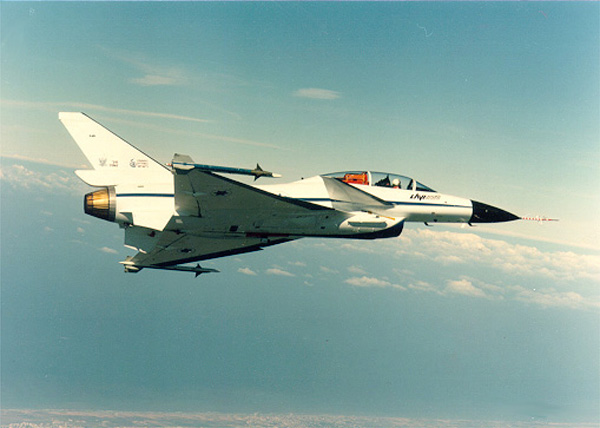
J-10 MULTIROLE FIGHTER AIRCRAFT
The Jian-10 (J-10) is the multirole fighter aircraft developed by
611 Aircraft Design Institute (Chengdu) and built by Chengdu
Aircraft Industry Corporation (CAC). Development of the J-10 began
in 1984 and the first low-rate initial production variant was
delivered to the PLA Air Force (PLAAF) in 2002. Around 300 aircraft
are expected to be built. The J-10 is available in two variants:
the single seat fighter J-10A and the two-seat fighter-trainer
J-10B.
PROGRAMME
The J-10 fighter was developed in the early 1980s as a counter to
the Soviet Unions emerging fourth-generation fighters such as the
MiG-29 Fulcrum and Su-27 Flanker. The original requirement was air
superiority, but the break-up of the Soviet Union and changing
requirements shifted development towards a high-performance
multirole fighter aircraft to replace the ageing J-6s and J-7s that
are the backbone of Chinas air force. The J-10 is based on the
Israel Aircraft Industries (IAI)s Lavi fighter. After the Lavi
programme was cancelled in 1987, its design was taken over by CAC,
and IAI carried on with the development of avionic equipment.
The PLAAF originally planned to fit the J-10 fighter with
Western-made turbofan engine and fire-control radar. Following the
event in June 1989, the U.S. and other Western countries imposed an
arms ban on China, which almost traumatised the J-10s development.
However, the end of the Cold War enabled China to seek advanced
aviation and defence technologies from its new alley Russia, who
agreed to provide the AL-31F turbofan engine to power the J-10. As
a result, the rear portion of the J-10s airframe had to be
re-designed to fit the Russian powerplant, and this has caused
further delays in the aircrafts development.
The J-10 first flew in 1998, but the aircraft suffered serious
problems with the fly-by-wire (FBW) software, which resulted in the
loss of the No.2 prototype and its pilot in 1999. After some
re-design work, the revised J-10 successfully flew in 1998. By 2000
a total of six prototypes (1001~1006) had been built. Three more
prototypes (1007~1009) were built between 2000 and 2002. The
low-rate initial production of the J-10 was authorised in 2002, and
the first batch is expected to include about fifty aircraft fitted
with Russian AL-31F engines. The two-seat J-10B fighter-trainer
aircraft successfully flew in 2003.
The J-10 is expected to achieve initial operating capability by
2005~2006, and the first operational regiment of the J-10 is
reported to be the PLAAF 44th Aviation Division based in Sichuan
Province. The PLAAF was estimated to have a total requirement of
300 aircraft, but this may be reduced to less than 100 as a result
of the introduction of the more capable Su-30MK multirole fighter.
The CAC is also trying to replace the Russian AL-31F with the
indigenously developed WS-10A, which is said to be a Chinese copy
of the AL-31FN. The J-10 may become available for export market in
2005~2006.
DESIGN
The single-engine J-10 fighter is similar in size to the Lockheed
Martin F-16, with a rectangle belly air intake, low-mounted delta
wings and a pair of from canard wings. The design is
aerodynamically unstable, to provide a high level of agility, low
drag and enhanced lift. The pilot controls the aircraft through a
computerised digital fly-by-wire (FBW) system, which provides
artificial stabilisation and gust elevation to give good control
characteristics throughout the flight envelope. The J-10 is also
the first Chinese-made fighter to be fitted with a large two-piece
bubble canopy to give the pilot a better view in close air
combat.
COCKPIT
The J-10's cockpit is fitted with three flat-panel liquid crystal
multifunction displays (MFDs), including one colour MFD, wide
field-of-view head-up display (HUD), and possibly helmet-mounted
sight (HMS). It is not know whether the HMS is the basic Ukrainian
Arsenel HMS copied by China's Luoyang Avionics, or a new helmet
display featured briefly at the 2000 Zhuhai air show.
The pilot manipulates the J-10 by the Iron Bird quadruple (four
channels) digital fly-by-wire (FBW) system. The pilot is also aided
by advanced autopilot and air data computer.
RADAR
The J-10 is reported to be fitted with an indigenous KLJ-3
pulse-Doppler fire-control radar developed by Nanjing Research
Institute of Electronic Technology (also known as 14th Institute).
The KLJ-3 radar, which might be based on early variant AN/APG-66/68
technology, is said to have a maximum detecting range of 100~130km
(attacking range 80~90km), and is capable of engaging two targets
simultaneously. The radar system was tested on a Y-7 aerial radar
testbed before being fitted on the J-10.
Russian company Phazotron is prompting its Zhuk-10PD, a version of
the system in later Su-27s, with 160km search range and ability to
track up to six targets. Israel has also offered its Elta EL/M-2035
radar for competition.
For low-level navigation and precision strike, a forward-looking
infrared and laser designation pod is likely to be carried
F-16-style on an inlet stores station. A Chinese designed pod
similar to the Israeli Rafael Litening was revealed at the 1998
Zhuhai air show.
POWERPLANT
The initial low-rate production J-10s are powered by the
27,500lb-thrust (120kN) Russian Lyulka-Saturn AL-31F turbofan rated
at 17,857 lb (79.43 kN) dry and 27,557 lb st (122.58 kN) with
afterburning. The same powerplant is also being used by Chinese air
force's Su-27s and Su-30s. Lyulka-Saturn reportedly delivered 54
AL-31F turbofan engines to China between 2002 and 2004. These are
the AL-31FN model with special modifications to be fitted in the
J-10.
China is also developing its own WS-10A turbofan powerplant, and it
could be fitted on the later versions of the J-10. An all-aspect
vectored-thrust version of the AL-31F was revealed for the first
time at Zhuhai Air Show 1998, leading to speculation that this
advanced engine may wind up on the J-10, potentially conferring
phenomenal manoeuvrability.
WEAPONS
The fixed weapon on the J-10 is a 23mm internal cannon. The
aircraft also has 11 stores stations - six under the wing and five
under the fuselage. The inner wing and centre fuselage stations are
plumped to carry external fuel tanks. Fixed weapon is a 23-mm inner
cannon hidden inside fuselage.
In addition to the PL-8 short-range infrared-guided air-to-air
missile reportedly derived from Israeli Rafael Python-3 technology,
the J-10 could also carry Russian Vympel R-73 (AA-11) short-range
and R-77 (AA-12) medium-range missiles equipped by Chinese
Flankers. It may also be fitted with indigenously developed PL-11
or PL-12 medium-range AAM for BVR combat.
For ground attack missions, the J-10 will carry laser-guided bombs,
YJ-8K anti-ship missile, as well as various unguided bombs and
rockets. Some missiles currently under development such as the YJ-9
ramjet-powered anti-radiation missile may also be carried by the
J-10.
SPECIFICATIONS
Crew: 1 (basic variant); 2 (fighter-trainer variant)
Dimensions: N/A
Weight: N/A
Max Speed: Mach 1.2 (sea-level) or Mach 2.0 (high altitude)
Range: Combat radius over 550km
Service Ceiling: N/A
Max Climb Rate: N/A
G Limit: N/A