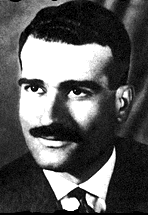
Part 2
With time he was taken even more into the confidence of the highest
echelons of power. He became a confidante of George Saif, high up
in the Ministry of Information. "The complete trust Cohen enjoyed
among his unwitting informants is illustrated by the following
incident, which might have serious consequences for the Israeli
agents.
One day Cohen was sitting in Saif's office reading a classified
document while the Syrian was on the phone. One of the ministry's
directors entered the room unannounced.
'How is it that you dare allow a stranger to read a classified
document?' he angrily asked Saif.
Saif calmly replied, 'There's nothing to worry about. He's a
trusted friend.'"
When the Ba'ath took power in 1963, Eli was firmly entrenched in
Syrian high society. Meanwhile, every few days he transmitted
important information to his Israeli handlers via a radio
transmitter he had hidden in his room.
Periodically Eli would return to Israel to speak with his Israeli
handlers and visit his wife and small children. Altogether, he
returned to Israel three times between 1962 and 1965.
At the beginning of this lecture we talked about the Syrian project
to divert water from the headwaters of the Jordan away from Israel.
Eli was friends with two highly placed Army officers, Colonels
Hatoum and Dali, who were fully informed about the scheme. In early
1964, Eli was able to radio Tel Aviv that the channel was being dug
along the entire length of the Syrian Heights to receive the
diverted flow of the Baniyas River - one of the Jordan's major
sources - and empty into Jordanian territory." Eli carefully
spelled out all the details of the project and passed them on to
Israeli Intelligence. Due to this information, the Israeli Air
Force was able to obliterate the Syrian plans for the diversion
scheme by shelling and bombing the bulldozers and other equipment
used for the scheme in early 1964.
Eli's connections enabled him to be taken to the Golan Heights - a
major strategic asset for Syria from 1948-67. As we saw, the
Syrians continually harassed Israel's northern settlements from
1948-67. The Golan Heights defenses were top-secret and closed only
to top military staff. "Nevertheless, Kamal Amin Ta'abet (Eli
Cohen) succeeded in visiting each and every position. With senior
staff officers acting as guides, Eli Cohen was provided an in-depth
intelligence briefing of monumental proportions." They even
photographed Eli on the Golan Heights, looking over into Israel,
alongside the most high-ranking Syrian officers. He remembered and
passed on to Israeli Intelligence the "positioning of every Syrian
gun, trench, and machine-gun nest in each Golan Heights
fortification; tank traps, designed to impede any Israeli attack,
were also identified and memorized for future targeting." One of
the more famous aspects of his spying regarded a trip he took to
the Golan Heights. As the Syrian Army officer explained to Eli the
fortifications the Syrian Army had built, Eli suggested that the
Syrians plant trees there to deceive the Israelis into thinking it
was unfortified, as well as to provide shade and beauty for the
soldiers stationed there. The Syrian officer readily agreed - and
Eli immediately passed the information onto Israel. Based on the
eucalyptus trees, Israel knew exactly where the Syrian
fortifications were.
Eli's friendship with Amin al-Hafez proved very valuable. After
Hafez became Prime Minister, Eli was even considered to be named
the Syrian Deputy Minister of Defense.
But changes were taking place in the Syrian Government that alarmed
Eli. In addition, the commander of Syrian Intelligence, Colonel
Ahmed Su'edani trusted no one and disliked Eli. Eli expressed his
fear and wish to terminate his assignment in Syria during his last
visit to Israel in November 1964. Still, Israeli Intelligence asked
him to return to Syria one more time. The information he had been
providing them for years was too good to forego.
Eli did go back to Syria, but his behavior changed. He became far
less careful in his transmissions to Israel, sometimes calling once
or even twice a day - and almost always at the same time, at 8:30
in the morning. The transmissions became longer as well. Some
attributed this to a sense of cockiness (despite the fears he had
expressed in November 1964), due to the ability and ease he had
moved about in the highest echelons of Syrian power. Others have
attributed the carelessness to an almost suicidal tendency -
perhaps, it was later surmised, he had been in the undercover world
too long, but knew he couldn't get out of it. Because of that,
perhaps he just tired of the whole charade.
The Syrians and their Russian advisers were alarmed by the
intelligence that was seeping out of the country. The highly
vigilant Russian security experts, equipped with very sensitive
technical intelligence-gathering equipment, pinpointed the source
of the transmissions in the Syrian capital - and it was Eli's home.
One day in January 1961, Syrian intelligence broke into his home in
the middle of a transmission. The leading figure in the break-in
was the head of Syrian Intelligence, Colonel Ahmed Su'edani - Eli's
nemesis.
Eli was caught in the act and there was nothing he could do. He was
tortured, but he wouldn't give away any incriminating information
about Israel. His captors later remarked on his noble bearing and
his courage despite the horrific Syrian interrogation
methods.
He then underwent a show trial, like the Operation Susannah spies
had in Egypt 12 years before., Like them, his verdict was
predetermined.
World leaders, wealthy individuals, the Israeli government, the
Pope, and others all intervened on his behalf. To no avail. He was
hanged on May 18, 1965. He wrote a last letter to his wife before
he mounted the scaffold to a seething crowd. The execution was
broadcast on Syrian television. After his execution, a white
parchment filled with anti-Zionist writing was put on his body and
he was left hanging for six hours.
Eli Cohen provided an incredible amount of intelligence data to the
Israeli Army over a period of three years. In 1967, the Israelis
were able to conquer the Golan Heights in two days - in part due to
the intelligence he provided. As Intelligence Chief Meir Amit said,
Eli "succeeded far beyond the capabilities of most other
men."
What is perhaps most amazing about Eli Cohen is that he was
genuinely liked - even loved - by so many of the top Syrian
leaders. He had an input into and an impact on Syrian national
defense, and was privy to almost all of their secrets. He genuinely
fit into life in the Syrian capital and he was never suspected of
being a spy until almost the very end.
It is for these reasons Eli Cohen is known as Israel's greatest
spy.
Enjoy lah