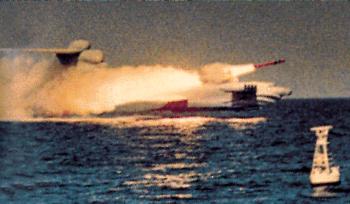
Moskit the aircraft carrier killer.
source: www.globalsecurity.com
The NATO designation SS-N-22 Sunburn is believed to be designated
P270 Moskit, the air-breathing variant of the naval missile 3M80
(the designation 3M80 apparently referring to the Mach 3 speed of
1980 weapons). It may have been designed originally to enhance the
effectiveness of Missile Cutter Brigades (that is, units of
missile-equipped FACs) and Destroyer Brigades hitherto dependent
upon the Malachit or SS-N-9 Siren. It is used on "Sovremennyy"
destroyers (eight missiles on each) and on "Tarantul [Tarantula]
III patrol ships (four missiles on each). A high supersonic speed
was specified to reduce the targets time to deploy self-defense
weapons, indeed the weapon was designed specifically to strike
ships with the Aegis command and weapon control system and the SM-2
surface-to-air missile.
The Moskit (3M80) is a ramjet-powered missile with a slim forward
body and ovoid nose, and a fatter rear half with four divided air
intakes. There are four clipped delta platform wings and four
smaller tail surfaces of similar shape organized in cruciform
configuration around the fuselage. All the wings and tail surfaces
are folded when the missile is in the launcher. Internally the
radar seeker is in the nose with the guidance system, batteries and
radio altimeter in the remainder of the front compartment, and the
300 kg semi-armor-piercing warhead immediately behind. A fuel tank,
presumably with a kerosene-type fuel, occupies the area to the
leading edges of the wing and the area almost to the rear edges is
occupied by the ramjet. Much of the rear of the missile is occupied
by a solid propellant booster through which runs the ramjet nozzle.
Actuators are to be found below the tail surfaces.
Fuselage - body of revolution with the ogival form of nose section
and the X-shaped wing arrangement and tail assembly. Wing and tail
assembly folding, made from the material OTYA and OTYA-Y, longerons
- from VKL -3. Four off-axis inlets and air ducts are located on
the housing. Front fairing with the radio-transparent spinner
(three-layered fairing from the fiberglass fabric scan -3 on the
connecting material K -9-70). Skin and intermediate collection it
is made from VT -5, tank compartment - made of the stainless steel,
longerons - from VKL -3, fairing - from the fiberglass fabric T -10
on connecting K -9-70. Air ducts of welded construction - from the
material OTYA-Y, OTYA.
The 3M82 "Mosquito" missiles have the fastest flying speed among
all antiship missiles in today's world. It reaches Mach 3 at a high
altitude and its maximum low-altitude speed is M2.2, triple the
speed of the American Harpoon. The missile takes only 2 minutes to
cover its full range and manufacturers state that 1-2 missiles
could incapacitate a destroyer while 1-5 missiles could sink a
20000 ton merchantman. An extended range missile, 9M80E is now
available.
When slower missiles, like the French Exocet are used, the maximum
theoretical response time for the defending ship is 150-120
seconds. This provides time to launch countermeasures and employ
jamming before deploying "hard" defense tactics such as launching
missiles and using quick-firing artillery. But the 3M82 "Mosquito"
missiles are extremely fast and give the defending side a maximum
theoretical response time of merely 25-30 seconds, rendering it
extremely difficult employ jamming and countermeasures, let alone
fire missiles and quick-firing artillery.
The air-launched version, officially called ASM-MMS and apparently
also Kh-4, is intended specially for Su-27K (Su-33) carrier-based
fighter aircraft. It was for the first time shown to the CIS
leaders in February 1992 in Machulishche and then to the public in
August 1992 at the Moscow Air Show in Zhukovskiy. The missile is
propelled by a dual (rocket-jet) engine operating by the same
principle as the Kh-31 engine. The missile, suspended under the
aircraft, has a folding wing. The missile is guided by an autopilot
during the initial fight stage, with possible correction by the
aircraft pilot, and by active radar during the final flight
stage.