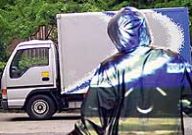
Quoted tt from Hpana.
Anyway, check this. they found ways to make things appear
invisible.
http://www.int.iol.co.za/index.php?from=rss_News&set_id=1&click_id=&art_id=qw1148593686914B252
Washington - New materials that can change the way light and other
forms of radiation bend around an object may provide a way to make
objects invisible, researchers said on Thursday.
Two separate teams of researchers have come up with theories on
ways to use experimental "metamaterials" to cloak an object and
hide it from visible light, infrared light, microwaves and perhaps
even sonar probes.
Their work suggests that science-fiction portrayals of
invisibility, such as the cloaking devices used to hide space ships
in Star Trek, might be truly possible.
Invisibility may be possible
Harry Potter's cloak or The Invisible Man of films and fiction
might be a bit harder to emulate, however, because the materials
must be used in a thick shell.
The concept begins with refraction - a quality of light in which
the electromagnetic waves take the quickest, but not necessarily
the shortest, route. This accounts for the illusion that a pencil
immersed in a glass of water appears broken, for instance.
"Imagine a situation where a medium guides light around a hole in
it," Physicist Ulf Leonhardt of Britain's University of St Andrews,
wrote in one of the reports, published in Friday's issue of the
journal Science.
The light rays end up behind the object as if they had travelled in
a straight line.
"Any object placed in the hole would be hidden from sight. The
medium would create the ultimate optical illusion: invisibility,
Leonhardt wrote.
'Think of space as a woven cloth'
"Such devices may be possible. The method developed here can be
also applied to escape detection by other electromagnetic waves or
sound."
The theory is different from that used on modern "stealth" bombers,
for example, which bounce radar off their surfaces so they cannot
be seen.
Instead, an object would be encased in a shell of metamaterials and
they would create an illusion akin to a mirage, said David Schurig
of Duke University in North Carolina, who worked on the second
report.
Metamaterials are composite structures that deliberately resemble
nothing found in nature. They are engineered to have unusual
properties, such as the ability to bend light in unique ways.
Like all physics, the invisibility idea requires a little
imagination.
"Think of space as a woven cloth," Shurig said in a telephone
interview. "Imagine making a hole in the cloth by inserting a
pointed object between the threads without tearing them."
The light, or microwaves, or radar would travel along the threads
of the cloth, ending up behind the object without having touched
it.
"You just need the right set of material properties and you can
guide light," Shurig said.
The Duke lab started working on metamaterials with a grant from the
Defence Advanced Research Projects Agency. Such materials could
provide super-light electronics in aircraft or cars, or highly
efficient lenses.
Working with John Pendry of Imperial College London, Shurig and
David Smith at Duke came up with the idea of using these materials
to bend light and other electromagnetic radiation.
"We are going to try to have an experimental demonstration of these
effects. There are a few more steps to go. We are working on these
steps," Smith said in a telephone interview.
Anyone making such a cloak would have to choose what form of
radiation one wanted invisibility from, Shurig said. The
invisibility would work both ways - a person hidden from the
visible light spectrum would have to use infrared or sonar or
microwaves to see out, he said.
"If want to cover the whole visible spectrum that would a tall
order," Shurig said.
I dug out a few pic.