Japan says lunar orbiter launch a success
by Staff Writers
Tokyo (AFP) Sept 14, 2007
Japan's first lunar orbiter successfully blasted into space Friday
on the most extensive mission to investigate the moon since the US
Apollo programme began nearly four decades ago, officials
said.
A domestically developed rocket launched with no glitches from a
small island in southern Japan at 10:31 am (0131 GMT) carrying the
country's hopes of restoring pride in its troubled space
programme.
The orbiter separated from the H-2A rocket about 45 minutes after
it took off from the Space Centre on the island of Tanegashima, the
space agency said.
"The launch was a success," declared Kaoru Mamiya, vice president
of the Japan Aerospace Exploration Agency in Tokyo.
"The probe detached from the rocket as expected 45 minutes after
lift-off and all the subsequent phases were carried out correctly,"
added Yoshisada Takizawa, the head of the project.
The lunar orbiter, aiming to collect data for research of the
moon's origin and evolution, will travel around the Earth before
moving into an orbit of the moon in early October, officials
said.
The agency says the one-year lunar mission, which is several years
behind schedule due to technical mishaps, is the most extensive
since the US Apollo programme began in the 1960s, putting the first
astronaut on the moon.
The explorer was named "Kaguya" after a beautiful princess who
charms many men before ascending to her home, the moon, in a
popular Japanese folk tale.
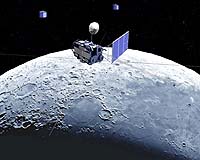
The 55-billion-yen (478-million-dollar) probe will consist of a
main unit, which will orbit 100 kilometres (60 miles) above the
moon, and two small satellites.
It will gather data on the distribution of chemical elements and
minerals as well as on topographical and surface structures.
The mission aims to study the gravity field and environment of the
moon while searching for hydrogen, which is required to for
water.
"Japan aims to build a station on the surface of the moon in 2025
and so we need to understand the moon. We need to develop the
fundamental technology," said Satoki Kurokawa, another spokesman
for the agency.
Japan has been expanding its space operations and has set a goal of
sending an astronaut to the moon by 2020.
It faced an embarrassing failure in November 2003, when it had to
destroy a rocket carrying a spy satellite 10 minutes after lift-off
because a booster failed to separate.
The setback came just a month after neighbouring China became the
third country to carry out a manned space mission. China is
pressing ahead with a programme that includes space walks and
dockings.
With the lunar orbiter, Japan hopes to keep the country one step
ahead of China and other regional rivals like India, which are also
expected to launch similar probes in coming months.
"This programme is very important for science throughout the world.
If it is completed successfully, it will push back the frontiers of
humanity beyond Earth and heighten Japan's technological status,"
said Hajime Inoue, director of space research at JAXA.
China is expected to launch its Chang'e 1 probe as early as this
month, to be followed by India's Chandrayaan 1 later this year.
NASA is expected to send up its own Lunar Reconnaissance Orbiter in
late 2008.
"China and India's scope of observation is different from ours,"
Kurokawa said. "They do not plan to focus on gravitational
attraction, surface layer and magnetic pull -- three areas I think
Kaguya can excel in."
Some experts, however, are cautious about the prospects for the
Japanese mission.
"I'm sure technical difficulties will pop up which will be the
first thing scientists will have to deal with," said Jun Nishimura,
professor emeritus of space physics at Tokyo University, who
questioned whether the mission would be able to complete all its
research in one go.
"Technical sticking points will surface and solving them will pave
the way for improvements," he said.
http://www.moondaily.com/reports/Japan_says_lunar_orbiter_launch_a_success_999.html