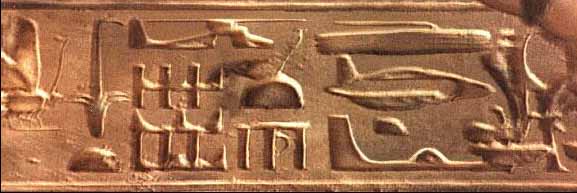
U can give this book a try:
reviewed by Theresa Welsh
If you're into alternative theories of history, eventually you'll
come across books by David Hatcher Childress. I admit I avoided
them for some years, as they seemed too far out on the fringe even
for me. But I could not resist this book about ancient flying
machines when I found a mint-condition copy at a used book sale.
Childress is not the first author to write about the "vimanas"
mentioned in an ancient manuscript from India called the
Mahabarata. Other authors have felt this puzzling source not only
tells us about sophisticated flying ships, but also tells of
nuclear wars raining terrible destruction on an apparently highly
advanced civilization.
This particular Childress book is a hodge-podge of essays,
pictures, and a complete translation of the "Vymaanika-Shaastra or
Science of Aeronautics," purportedly a part of the famous
Mahabarata, and found in an Indian library in 1908. This version is
translated from the Sanskrit by one G.R. Joyser. The illustrations
in the book make it worthwhile, as they are gathered from many
sources and give numerous renditions of what the vimanas (from the
Rama Empire of India) and the vailxi (from Atlantis) looked like.
Okay, so these are just drawings and may arise only out of
someone's imagination, but we cannot forget that much technology of
today was predicted by novelists of yesterday.
Not all the illustrations are just imaginary though. The Sanskrit
document included with the book gives detailed descriptions of how
to build various kinds of vimanas. They were mainly powered by
Mercury and magnetics. They were mainly saucer-shaped with a pole
up the center. I will not attempt to explain, as the technical
aspects are pretty obscure. I only skimmed the translated document,
since it really is of little value to the casual reader. There are
so many references to things that are unknown today, and words that
have no meaning, and procedures that seem to make no sense. How can
we be sure the translator has made sense of the original? Here is a
randomly-selected passage, describing "Praana - Kundalinee
Yantra"
"A peetha or stand 3 feet in diameter and 3 feet high, square or
circular, should be made of vrishala metal, with 8 kendras or
central spots. In each central spot, two wheels with revolving
hinges; small peethas or plates with 3 holes, 4 teeth, 3 pivots, in
their middle a central pivot, 3 red-colored tubes or pipes with
opening and closing wheels, and switches for right motion, and
reverse motion, with a shabda-nala in the center, with wheels (with
hinges and rods) which will flap the wings; from the north-east and
south-east Kendra and the middle Kendra in the west up to the
middle of the course of the yaana kundalinee revolving wheels with
pivots."
Reading this passage makes you yearn for a blueprint. How can
anyone possibly evaluate such descriptions? Because the
descriptions are so detailed (giving exact measurements and
materials), they DO seem to arise from something real. But it is
far from certain that anyone today could build anything from these
descriptions.
The material on the Atlantis Vailxi is equally unreliable, but
worthy of notice. The term "vailxi" (singular: vailx) comes mainly
from an old occult manuscript called A Dweller on Two Planets, and
from Edgar Cayce readings. A Dweller on Two Planets was dictated by
automatic writing in 1883 by "Phylos the Thibetan," a spirit. It is
a rambling story of many incarnations, including lives in Atlantis.
The book includes illustrations of the vailxi that the author
traveled in. These are long cigar-shaped craft that can go in the
air or water. Edgar Cayce described similar vessels in his life
readings for people who had previous incarnations in Atlantis. In
the Cayce readings, the power source was a huge crystal kept in a
domed building. The dome opened to catch the sun. This wireless
source of power is reminiscent of Nikola Tesla's tower, which he
said could supply power remotely. Unfortunately, Tesla went broke
and his tower was destroyed before it could be put in
operation.
This book contains some interesting speculation about
electromagnetism and its relationship to gravity. The author
discusses the work of William Clendenon (with whom he has written a
more recent book, Atlantis and the Power System of the Gods:
Mercury Vortex Generators and the Power Systems of Atlantis). He
believes the caduceus, with its two snakes wound around a rod, and
symbolic of the god Mercury, is an ancient indicator of flight
powered by mercury andmagnetics. The central rod corresponds to the
one in the vimanas. Further, Clenendon claims to have built vimanas
that fly!