Singapore's cityscape is ever changing. The pace of urban
renewal is fast. Yet there are still some buildings that remain as
memories of days gone by.
This is my thread on the bungalows, villas, mansions, houses and
residences from the past. Included here are pictures, address, date
of completion and any info I can find.
Update on list:
Sun Yat-Sen Villa, 12 Tai Gin Road
Unnamed mansion, St Patrick's Road
Unnamed villa, Joo Chiat Road, East Coast Road end
India House, 31 Grange Road
Flagstaff House, 64 Sime Road
Old Admiralty House, 345 Old Nelson Road
Chee Guan Chiang House, 25 Grange Road
Unnamed villa, 25 Grange Road
233 Pasir Panjang Road
10 Gilstead Road
Field House, 25 Gilstead Road
42 Gilstead Road
Command House, 17 Kheam Hock Road
Golden Bell, 10 Pender Road
2 Bedok Avenue
Karikal Mahal, 25 Still Road South
_____________________________________________________________
First, historically the most important and valuable house:
Sun Yat Sen Villa (1900s), 12 Tai Gin Road

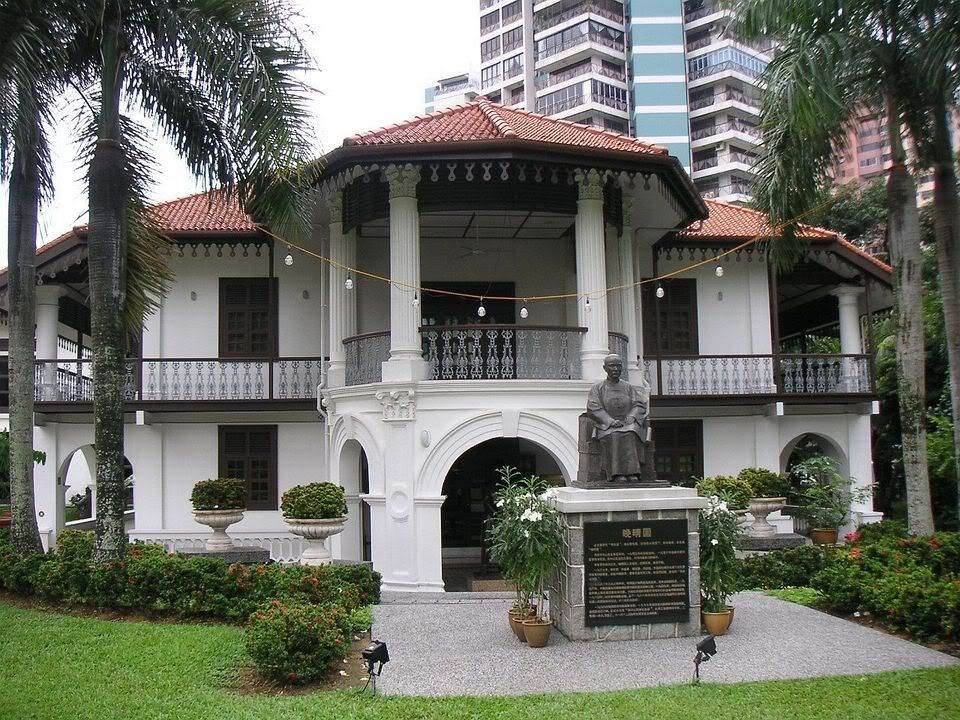
Wan Qing Yuan was built in late 19th Century. The villa was bought
by rubber magnate Teo Eng Hock for his mother, Mdm Tan Poh Neo. A
fervent supporter of the Chinese revolutionary cause, Teo Eng Hock
later offered the place to Dr Sun for his revolutionary activities
in February 1906. After the success of the 1911 Revolution, Wan
Qing Yuan was subsequently entrusted to the then Singapore Chinese
Chamber of Commerce (now Singapore Chinese Chamber of Commerce
& Industry, SCCCI).
In December 1964, the Singapore Chinese Chamber of Commerce
revamped the villa to commemorate Dr Sun and his revolutionary
movement. The project was completed in 1965 and the villa became Dr
Sun Yat Sen Villa.
After Dr Sun Yat Sen Villa was gazetted a national monument in 1994
by the Preservation of Monuments Board, the SCCCI renamed the villa
as Sun Yat Sen Nanyang Memorial Hall in 1996 to trace Dr Sun's
revolutionary activities in the Southeast Asian region. A
subsidiary company, Sun Yat Sen Nanyang Memorial Hall Co Ltd, was
set up in 1997 to spearhead the restoration project.
A restoration team was formed under the initiative of Mr Kwek Leng
Joo, President of SCCCI. Led by Mr Kwek personally and comprising
five committees sharing the same vision, the team planned and
implemented over four years to transform the villa into a memorial
hall.
After four years of restoration works and funding amounting more
than $8 million, the Memorial Hall was completed in October 2001.
On 12 November 2001, it was officially opened by Senior Minister
Lee Kuan Yew.
______________________________________________________________
1900 - 1906:
Built in 1900, this double-storey bungalow (formerly known as Bin
Chan House) was initially built for the beloved mistress of wealthy
businessman Boey Chuan Poh. Years later, rubber magnate Mr Teo Eng
Hock acquired the residence for his aged mother, Mdm Tan Poh Neo.
The villa was then given a new Chinese name, Wan Qing Yuan ( 晚晴园 ),
to symbolise peace and happiness in his mother's twilight years. A
fervent supporter of the Chinese revolutionary cause, Mr Teo Eng
Hock later offered the place to Dr Sun Yat Sen for his
revolutionary activities in February 1906.
1906 - 1911:
Dr Sun Yat Sen chose Singapore as the nerve centre of his
revolutionary movement (Tong Meng Hui) in Southeast Asia, due to
its excellent geographical location as a port of call and its
considerable Chinese immigrant population. It was in this villa
that Dr Sun led numerous red-blooded Chinese men in the planning of
several uprisings against the Manchu (Qing) government. Shining
examples include the Zhennanguan and Huanggang uprisings.
Dr Sun came to Singapore on eight separate occasions. His third and
final visit to the villa was in 1910 before leaving for Penang with
his family. In 1911, the Wuchang Uprising succeeded and he went on
to be inaugurated the first Provisional President of the Republic
of China.
As years passed by, gone were the days of glory. Teo Eng Hock lost
much of his wealth after 1911 and the villa was subsequently sold
to an Indian merchant as a private residence.
1937 - 1938:
In 1937, six former comrades of Dr Sun Yat Sen - Messrs Lee Kong
Chian, Lee Chin Tian, Lee Choon Seng, Tan Ean Kiam, Chew Hean Swee
and Yeo Kiat Tiow, jointly acquired the villa and offered the place
to the Chinese Nanjing Republican Government in 1938. The villa was
placed under the care of the Singapore Chinese Chamber of
Commerce.
1942 - 1945:
During the Japanese Occupation, the villa was used as a Japanese
Communication Centre and Kempeitai branch.
1964 - 1966:
In December 1964, the Chinese Chamber of Commerce decided to revamp
the villa to commemorate Dr Sun and his revolutionary movement. The
project was completed in 1965. That November 12, Dr Sun's 99th
birthday was celebrated at the villa. In 1966, the Chinese Chamber
of Commerce exhibited the remains of the civilians who perished
during the Japanese Occupation at the villa. At this point, the
villa had two exhibitions - Dr Sun's artefacts and pictures, and
the remains of the victims of war.
1994 - 1997:
The villa was gazetted a national monument in 1994 by the
Preservation of Monuments Board. It was renamed Sun Yat Sen Nanyang
Memorial Hall in 1996 to trace Dr Sun's revolutionary activities in
the Southeast Asian region, especially in Singapore and Malaya,
before he successfully ended the reign of the Qing Dynasty in
China. The memorial hall was closed to the public in 1997 for
renovation and expansion.
2001:
The rejuvenated memorial hall opens its doors on 12 November 2001
to coincide with Dr Sun's 135th birthday.


