Royal Greenwich
Observatory
The original site of the Royal Greenwich
Observatory (RGO), which was built as a workplace for the
Astronomer Royal, was on a hill in Greenwich Park in Greenwich,
London, overlooking the River Thames. The Prime Meridian, to which
longitude refers, went through the observatory. It is marked by a
brass strip in the courtyard and, since December 16, 1999, a
powerful green laser shining north across the London night
sky.

Royal Greenwich
Observatory
The observatory was commissioned in 1675 by King Charles II.
Flamsteed House (1675-76), the original part of the Observatory,
was designed by Sir Christopher Wren and was the first
purpose-built scientific research facility in Britain.
The last time that all departments of the RGO were at Greenwich was
before World War II. Many departments were evacuated along with the
rest of London to the countryside (Abinger, Bradford, and Bath) in
1939. After the War, in 1947, the decision was made to move to
Herstmonceux Castle and 320 adjacent acres (1.3 km²) (70 km
south-southeast of Greenwich near Hailsham in East Sussex) due to
light pollution in London. Although the Astronomer Royal moved to
the castle in 1948, the scientific staff could not move until the
completion of new observatory buildings in 1957. Shortly
thereafter, other far flung departments were reintegrated at
Herstmonceux.

Former Royal Greenwich
Observatory, Herstmonceux East Sussex
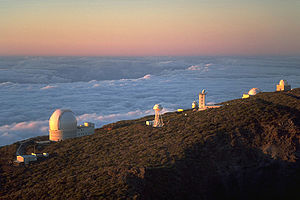
The Isaac Newton Telescope was built there in 1967, but was moved
to Roque de los Muchachos Observatory in Spain's Canary Islands in
1979. In 1990 the RGO moved again, to Cambridge. Following a
decision of the Particle Physics and Astronomy Research Council, it
closed in 1998. Her Majesty's Nautical Almanac Office was
transferred to the Rutherford Appleton Laboratory after the
closure. Other work went to the UK Astronomy Technology Centre in
Edinburgh. The castle now houses the International Study Centre of
Queen's University, Kingston, Canada and the Observatory Science
Centre.
Greenwich Mean Time was at one time based on the time observations
made at Greenwich, before being superseded by Coordinated Universal
Time. While Greenwich no longer hosts a working astronomical
observatory, it remains a centre of excellence for modern
astronomy.
A time ball still drops daily to mark the exact moment of 1 pm
(13:00) - this was installed by Astronomer Royal John Pond in 1833.
There is a good museum of astronomical and navigational tools,
notably including John Harrison's prize-winning longitude
chronometer, H4. In February 2005 construction work began on a £15
million redevelopment project which will provide a new planetarium
and additional display galleries and educational facilities.
Chronology
-- 1675 Royal Observatory founded.
-- 1924 Hourly time signals (Greenwich Time Signal) from the
Greenwich Observatory were first broadcast on February 5.
-- 1948 Astronomer Royal moves to Herstmonceux.
-- 1957 Royal Observatory completes its move to Herstmonceux,
becoming the Royal Greenwich Observatory (RGO). The Greenwich site
becomes the Old Royal Observatory.
-- 1990 RGO moves to Cambridge.
-- 1998 RGO closes. Greenwich site becomes the Royal Observatory,
Greenwich, and is part of the National Maritime Museum.
Issue #127