Planet
A planet (from Greek, meaning planetes or
"wanderers") is a body of considerable mass that orbits a star and
that produces no energy through nuclear fusion. Prior to the 1990s
only nine were known (all of them in our own solar system); as of 3
November 2004, 133 are known, with all of the new discoveries being
extrasolar planets, sometimes known as "exoplanets".
Planets are thought to form from the collapsing nebula that a
planet's star formed out of, aggregating from gas and dust that
orbits the protostar in a dense protostellar disk before the star's
core ignites and its solar wind blows the remaining material
away.
Within the solar system
Except for Earth (which was not perceived as being a planet by the
ancients), all of the accepted planets in the solar system are
named after Greek or Roman gods (however, some non-European
languages such as Chinese use different names). Moons are also
named after gods and characters from classical mythology or (in the
case of Uranus) from the plays of Shakespeare. Asteroids can be
named, at the discretion of their discoverers, after anybody or
anything (subject to approval by the International Astronomical
Union's panel on nomenclature). The act of naming planets and their
features is known as planetary nomenclature.
Accepted
planets
According to the authority of the International Astronomical Union,
there are nine planets in our solar system (in increasing distance
from the Sun):
Mercury
Venus
Earth - with the Moon
Mars - 2 satellites (Deimos, Phobos)
Jupiter - 63 confirmed natural satellites
Saturn - 30 confirmed satellites
Uranus - 27 moons
Neptune - 13 moons
Pluto (many astronomers think it should be classified only as a
Kuiper belt object and not also as a planet) - 1 satellite
Charon

The nine planets in our solar
system
Other
objects
Recently an object, 90377 Sedna, has been discovered orbiting the
Sun 90 AU (13 billion kilometres) away, three times farther than
Pluto. Sedna, after the Inuit goddess of the sea, is a 11802360 km
(730-1470 miles) diameter object. The diameter is still uncertain
but believed to be between 1/2 and 3/4 of Pluto's. Several news
sources have already reported Sedna as the tenth planet, but that is not generally accepted
by astronomers. Another possible planet is 90482 Orcus, an object
with an orbit and mass similar to Pluto's. Other candidates include
50000 Quaoar and 20000 Varuna.
Several hypothetical planets, like Planet X (supposedly beyond the
orbit of Pluto) or Vulcan (thought to orbit inside the orbit of
Mercury), were posited at various historical times, and were
subjects of intense searches that found nothing.
Classification
Astronomers distinguish between minor planets, such as asteroids,
comets, and trans-Neptunian objects; and major (or true)
planets.
Planets within Earth's solar system can be divided into categories
according to composition.
-- Terrestrial or rocky: Planets that are similar to Earth with
bodies largely composed of rock: Mercury, Venus, Earth, Mars
-- Jovian or gas giant: Those with a composition largely made up of
gaseous material: Jupiter, Saturn, Uranus, Neptune. Uranian planets
are a sub-class of gas giants, distinguished from true Jovians by
their depletion in hydrogen and helium and a significant
composition of rock and ice.
-- Icy: Sometimes a third category is added to include bodies like
Pluto, whose composition is primarily ice; this category of "icy"
bodies also includes many non-planetary bodies such as the icy
moons of the outer planets of our solar system (e.g. Triton).
The eight rocky and gaseous planets are universally recognized as
major planets. Ceres was called a planet when first discovered, but
was reclassified as an asteroid when many similar objects were
found. Given recent discoveries of many trans-Neptunian objects
which are very similar to Pluto in orbit, size and composition,
many people think it should be similarly redefined as a minor
planet. For example, Mike Brown of Caltech defines a planet to be:
any body in the solar system that is more massive than the total
mass of all of the other bodies in a similar orbit (link). Using this definition, neither Pluto nor
Sedna would be a major planet.
Many consider the Earth and its Moon to be a double planet, for
several reasons:
-- The Moon, as measured by its diameter, is 1.5 times larger than
Pluto.
-- The gravitational force of the Sun on the Moon is larger than
the gravitational force of the Earth on the Moon (by about a factor
of 2.2)
The latter fact is not unique in the solar system, but is unusual
for such a large satellite. Other satellites for which the Sun's
gravity is actually stronger than the primary's:
-- The outermost moon of Jupiter (S/2003 J 2; factor of 1.5)
-- The outermost moon of Uranus (S/2001 U 2; factor of 1.2)
-- The two outermost moons of Neptune (S/2002 N 4 and S/2003 N 1;
factor of 2.1)
-- Several asteroid moons (e.g. S/2001 (22) 1 Linus by a factor of
1.6; S/1998 (45) 1 Petit-Prince by a factor of 2.8; S/1993 243 (1)
Dactyl by a factor of 1.3; and, most remarkably, S/2001 (66391) 1
by a large factor of 625.)
Extrasolar planets
Most extrasolar planets (those outside our solar system) discovered
to date have masses which are about the same or larger than
Jupiter's.
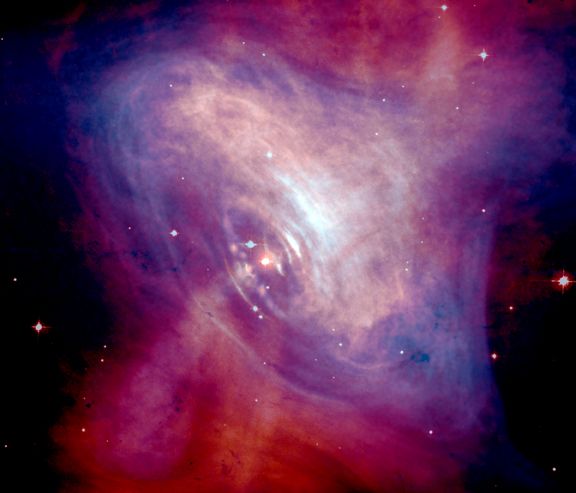
Exceptions include three planets discovered orbiting PSR B1257+12 a
burned-out star, or supernova remnant, called a pulsar, comparable
in size to the terrestrial planets; and planets orbiting the stars
Mu Arae, 55 Cancri and GJ 436 which are approximately neptune sized
(link).
It is far from clear if the newly discovered large planets would
resemble gas giants in our solar system or if they are of an
entirely different type or types which are unknown in our solar
system. In particular, some of the newly discovered planets, known
as hot Jupiters, orbit extremely close to their parent star, in
nearly circular orbits. They therefore receive much more stellar
radiation than the gas giants in our solar system, which makes it
questionable whether they are the same type of planet at all.
The National Aeronautics and Space Administration of the United
States has a program underway to develop a Terrestrial Planet
Finder artificial satellite, which would be capable of detecting
the planets with masses comparable to terrestrial planets. The
frequency of occurrence of these planets is one of the variables in
the Drake equation which estimates the number of intelligent,
communicating civilizations that exist in our galaxy.
Interstellar planets are rogues in interstellar space, not
gravitationally linked to any given solar system. No interstellar
planet is known to date, but their existence is considered a
plausible hypothesis on the grounds that the results of computer
simulations of the origin and evolution of planetary systems often
include the formation and subsequent ejection of bodies of
significant mass.
Current technology is not sensitive enough to detect planets of
relatively small mass and orbiting far because such planets cause
very small "wobble effect" on their star. Discoveries of smaller
planets will require radical improvements in telescopes.
Issue #31