Astronomy Picture of the Day
2006 June 20

Hideaway
Explanation: Is
this a picture of a sunset from Earth's North Pole? Regardless of
urban legends circulating the Internet, the answer is no. The above
scene was drawn to be an imaginary celestial place that would be
calm and peaceful, and therefore titled Hideaway. The scene could
not exist anywhere on the Earth because from the Earth, the Moon
and the Sun always have nearly the same angular size. This is
particularly apparent, for example, during solar eclipses. Still,
the scene drawn is quite striking, and the crescent part of the
"moon" shown is approximately accurate given the location of the
parent star. In reality, the North Pole of Earth looks different.
Starting earlier this month, the North Pole even has a web camera
returning near-live pictures.
Illustration &
Copyright: Inga Nielsen
Astronomy Picture of the Day
2006 June 21

Sunrise Solstice at Stonehenge
Explanation: Today
the Sun reaches its northernmost point in the planet Earth's sky.
Called a solstice, the date traditionally marks a change of seasons
-- from spring to summer in Earth's Northern Hemisphere and from
fall to winter in Earth's Southern Hemisphere. Pictured above is
the 2005 Summer Solstice celebration at Stonehenge in England. The
event was rare because Stonehenge was not always open to the
public, and because recent summer solstices there had been
annoyingly cloudy. In 2005, however, thousands of people gathered
at sunrise to see the sun rise through the 4,000 year old solar
monument. Due to the precession of the Earth's rotational axis over
the millennia, the Sun no longer rises over Stonehenge in an
astronomically significant way, although the photographer was able
to find a good spot where the rising Sun appeared over one of
Stonehenge's massive standing stones.
Credit &
Copyright: Pete Strasser (Tucson, Arizona, USA)
Astronomy Picture of the Day
2006 June 22

Planets, Bees, and a Donkey
Explanation: The
heralded alignment of wandering planets Saturn and Mars with the
well-known Beehive Cluster took place last weekend on Saturday,
June 17. Recorded in dark Arizona skies on that date, this view
finds Mars above and right of Saturn - the brightest celestial
beacons in the scene - with the Beehive cluster of stars (M44) at
the lower right. The two planets appear in conjunction separated by
just over half a degree. But about another half a degree along a
line joining the two and continuing towards the lower left lies the
third brightest object in the image, giant star Asellus Australis.
Asellus Australis is also known as Delta Cancri, a middling bright
star 136 light-years away in the constellation Cancer, the Crab. Of
course, this star's Latin name translates to "Southern
Donkey".
Credit &
Copyright: Chris Schur
Astronomy Picture of the Day
2006 June 23

East of Antares
Explanation: East
of Antares, dark markings seem to sprawl through the crowded star
fields toward the center of our Milky Way Galaxy. Cataloged in the
early 20th century by astronomer E. E. Barnard, the obscuring
interstellar dust clouds include B72, B77, B78, and B59, seen in
silhouette against the starry background. Here, their combined
shape suggests smoke rising from a pipe, and so the dark nebula's
popular name is the Pipe Nebula. This gorgeous and expansive view
was recorded in very dark skies over Hakos, Namibia. It covers a
full 10 by 7 degree field in the pronounceable constellation
Ophiuchus.
Credit &
Copyright: Johannes Schedler (Panther Observatory)
Astronomy Picture of the Day
2006 June 24

Nix and Hydra
Explanation:
Discovered in mid-2005, Pluto's small moons were provisionally
designated S/2005 P1 and S/2005 P2. They have now been officially
christened Nix and Hydra. Compared to Pluto and its large moon
Charon, at 2,360 and 1,210 kilometers in diameter respectively, Nix
(inner moon) and Hydra (outer moon) are tiny, estimated to be only
40 to 160 kilometers across. Pluto and Charon are bright enough to
create diffraction spikes in this Hubble Space Telescope image, but
Nix and Hydra are some 5,000 times fainter than Pluto and appear
only as small points of light. Still, their new names are
appropriate for the distant Pluto system. In mythology, Nix was the
goddess of darkness and night and the mother of Charon, while Hydra
was a nine headed monster and is now orbiting the solar system's
ninth planet. Of course Nix and Hydra also share initials with the
pluto-bound spacecraft New Horizons.
Image Credit: M.
Mutchler (STScI), A. Stern (SwRI), and the HST Pluto Companion
Search Team, ESA, NASA
Astronomy Picture of the Day
2006 June 25

M57: The Ring Nebula
Explanation: It
looked like a ring on the sky. Hundreds of years ago astronomers
noticed a nebula with a most unusual shape. Now known as M57 or NGC
6720, the gas cloud became popularly known as the Ring Nebula. It
is now known to be a planetary nebula, a gas cloud emitted at the
end of a Sun-like star's existence. As one of the brightest
planetary nebula on the sky, the Ring Nebula can be seen with a
small telescope in the constellation of Lyra. The Ring Nebula lies
about 4,000 light years away, and is roughly 500 times the diameter
of our Solar System. In this recent picture by the Hubble Space
Telescope, dust filaments and globules are visible far from the
central star. This helps indicate that the Ring Nebula is not
spherical, but cylindrical.
Credit: H. Bond et
al., Hubble Heritage Team (STScI / AURA), NASA
Astronomy Picture of the Day
2006 June 26

Starry Night
Explanation: The
painting Starry Night is one of the most famous icons of the night
sky ever created. The scene was painted by Vincent van Gogh in
southern France in 1889. The swirling style of Starry Night
appears, to many, to make the night sky come alive. Although van
Gogh frequently portrayed real settings in his paintings, art
historians do not agree on precisely what stars and planets are
being depicted in Starry Night. The style of Starry Night is
post-impressionism, a popular painting style at the end of the
nineteenth century. The original Starry Night painting hangs in the
Museum of Modern Art in New York City, New York, USA.
Credit: Vincent
van Gogh; Digital image courtesy of Wikipedia
Astronomy Picture of the Day
2006 June 27

The Moving Moons of Saturn
Explanation: The
moons of Saturn never stop. A space traveler orbiting the ringed
giant planet would witness a continuing silent dance where Saturn's
multiple moons pass near each other in numerous combinations. Like
a miniature Solar System, the innermost moons orbit Saturn the
fastest. The above movie was centered on Saturn's moon Rhea, so
that the moons Mimas and Enceladus appear to glide by. At 1,500
kilometers across, Rhea is over three times larger than the
comparably sized Mimas and Enceladus. The Sun illuminates the scene
from the lower right, giving all of the moons the same crescent
phase. The above time lapse movie was created by the
Saturn-orbiting robotic Cassini spacecraft over a period of about
40 minutes.
Credit: Cassini
Imaging Team, SSI, JPL, ESA, NASA
Astronomy Picture of the Day
2006 June 28

The Cat's Paw Nebula
Explanation:
Nebulae are perhaps as famous for being identified with familiar
shapes as perhaps cats are for getting into trouble. Still, no
known cat could have created the vast Cat's Paw Nebula visible in
Scorpius. At 5,500 light years distant, Cat's Paw is an emission
nebula with a red color that originates from an abundance of
ionized hydrogen atoms. Alternatively known as the Bear Claw Nebula
or NGC 6334, stars nearly ten times the mass of our Sun have been
born there in only the past few million years. Pictured above, a
deep wide-field image of the Cat's Paw nebula was photographed from
New South Wales, Australia.
Credit &
Copyright: Robert Gendler & Martin Pugh
Astronomy Picture of the Day
2006 June 29

Old Moon and Sister Stars
Explanation: An
old crescent Moon shares the eastern sky over Menton, France with
the sister stars of the Pleiades cluster in this early morning
skyscape recorded just last Friday, June 23rd. (Bright Venus was
also near the eastern horizon, but is not pictured here.)
Astronomical images of the well-known Pleiades often show the
cluster's alluring blue reflection nebulae, but they are washed out
here by the bright moonlight. Still, while the crescent Moon is
overexposed, surface features can be seen on the dim lunar night
side illuminated by earthshine - light from sunlit planet Earth. Of
course, you can spot a young crescent Moon in the early evening sky
tonight. Having left the Pleiades behind, a lovely lunar crescent
now appears in the west, lining up with planets Mars, Saturn, and
Mercury along the solar system's ecliptic plane.
Credit &
Copyright: Vincent Jacques
Astronomy Picture of the Day
2006 June 30

The Antennae
Explanation: Some
60 million light-years away in the southerly constellation Corvus,
two large galaxies have collided. But stars in the two galaxies -
NGC 4038 and NGC 4039 - don't collide in the course of the
ponderous, billion year or so long event. Instead, their large
clouds of molecular gas and dust do, triggering furious episodes of
star formation. Spanning about 500 thousand light-years, this
stunning view reveals new star clusters and matter flung far from
the scene of the accident by gravitational tidal forces. Of course,
the visual appearance of the far-flung arcing structures gives the
galaxy pair its popular name - The Antennae. Recorded in this deep
image of the region at the tip of the upper arc is a tidal dwarf
galaxy NGC 4038S, formed in the cosmic debris.
Credit &
Copyright: Daniel Verschatse (Antilhue Observatory)
Astronomy Picture of the Day
2006 July 1

Wind from a Black Hole
Explanation:
Binary star system GRO J1655-40 consists of a relatively normal
star about twice as massive as the Sun co-orbiting with a black
hole of about seven solar masses. This striking artist's vision of
the exotic binary system helps visualize matter drawn from the
normal star by gravity and swirling toward the black hole. But it
also includes a wind of material escaping from the black hole's
accretion disk. In fact, astronomers now argue that Chandra
Observatory x-ray data indicate a high-speed wind is being driven
from this system's disk by magnetic forces. Internal magnetic
fields also help drive material in the swirling disk into the black
hole itself. If you had x-ray eyes as good as Chandra's, you could
find GRO J1655-40 about 11,000 light-years away in the
constellation Scorpius.
Illustration
Credit: M. Weiss (CXC), NASA
Astronomy Picture of the Day
2006 July 2
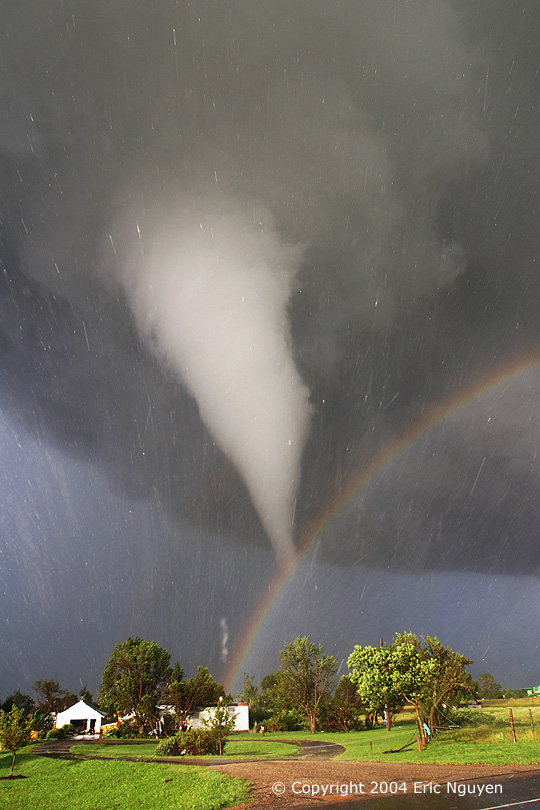
Tornado and Rainbow Over Kansas
Explanation: The
scene might have been considered serene if it weren't for the
tornado. Last June in Kansas, storm chaser Eric Nguyen photographed
this budding twister in a different light -- the light of a
rainbow. Pictured above, a white tornado cloud descends from a dark
storm cloud. The Sun, peeking through a clear patch of sky to the
left, illuminates some buildings in the foreground. Sunlight
reflects off raindrops to form a rainbow. By coincidence, the
tornado appears to end right over the rainbow. Streaks in the image
are hail being swept about by the high swirling winds. Over 1,000
tornadoes, the most violent type of storm known, occur on Earth
every year, many in tornado alley. If you see a tornado while
driving, do not try to outrun it -- park your car safely, go to a
storm cellar, or crouch under steps in a basement.
Credit &
Copyright: Eric Nguyen (Oklahoma U.), www.mesoscale.ws
Astronomy Picture of the Day
2006 July 3

The View toward Husband Hill on Mars
Explanation: This
Martian vista is only part of one of the greatest panoramic views
of Mars that has ever attempted. The expansive mosaic is helping to
keep the robotic Spirit rover busy over the energy draining winter
in the southern hemisphere of Mars. During the winter, Spirit is
constrained to stay on the side of McCool Hill in order to keep its
solar panels pointed toward the Sun. The panorama has so far
involved over 800 exposures, very little digital compression, and
will take over a month to complete. The view shown is toward
Husband Hill, a hill that Spirit climbed last year. A careful
inspection of the above image shows tracks crossing from the center
to the right.
Credit: Mars
Exploration Rover Mission, Cornell, JPL, NASA
Astronomy Picture of the Day
2006 July 4

Elliptical Galaxy Centaurus A from CFHT
Explanation: Why
is peculiar galaxy Centaurus A so dusty? Dramatic dust lanes that
run across the galaxy's center mark Cen A. These dust lanes are so
thick they almost completely obscure the galaxy's center in visible
light. This is particularly unusual as Cen A's red stars and round
shape are characteristic of a giant elliptical galaxy, a galaxy
type usually low in dark dust. Cen A, also known as NGC 5128, is
also unusual compared to an average elliptical galaxy because it
contains a higher proportion of young blue stars and is a very
strong source of radio emission. Evidence indicates that Cen A is
likely the result of the collision of two normal galaxies. During
the collision, many young stars were formed, but details of the
creation of Cen A's unusual dust belts are still being researched.
Cen A lies only 13 million light years away, making it the closest
active galaxy. Cen A, pictured above, spans 60,000 light years and
can be seen with binoculars toward the constellation of
Centaurus.
Credit &
Copyright: Jean-Charles Cuillandre (CFHT), Hawaiian
Starlight, CFHT
Astronomy Picture of the Day
2006 July 5

Spiral Galaxy NGC 2403 from Subaru
Explanation:
Sprawling spiral arms dotted with bright red emission nebulas
highlight this new and detailed image of nearby spiral galaxy NGC
2403. Also visible in the photogenic spiral galaxy are blue open
clusters, dark dust lanes, and a bright but relatively small
central nucleus. NGC 2403 is located just beyond the Local Group of
Galaxies, at a relatively close 10 million light years away toward
the constellation of the Giraffe (Camelopardalis). NGC 2403 has a
designated Hubble type of Sc. In 2004, NGC 2403 was home to one of
the brightest supernovas of modern times. The above image, the
highest resolution complete image of NGC 2403 ever completed, was
taken by the Japan's 8.3-meter Subaru telescope located on Mauna
Kea, Hawaii, USA.
Credit &
Copyright: Suprime-Cam, Subaru Telescope, NAOJ
Astronomy Picture of the Day
2006 July 6
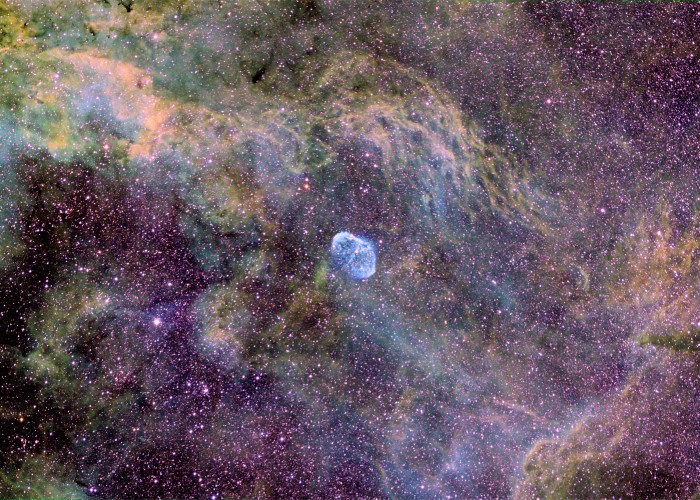
NGC 6888: A Tricolor Starfield
Explanation: NGC
6888, also known as the Crescent Nebula, is a cosmic bubble about
25 light-years across, blown by winds from its central, bright,
massive star. Near the center of this intriguing widefield view of
interstellar gas clouds and rich star fields of the constellation
Cygnus, NGC 6888 is about 5,000 light-years away. The three color
composite image was created by stacking exposures through narrow
band filters that transmit the light from atoms in the clouds.
Hydrogen is shown as green, sulfur as red, and oxygen as blue. NGC
6888's central star is classified as a Wolf-Rayet star (WR 136) and
is shedding its outer envelope in a strong stellar wind, ejecting
the equivalent of our Sun's mass every 10,000 years. Burning fuel
at a prodigious rate and near the end of its stellar life, this
star should ultimately go out with a bang in a spectacular
supernova explosion.
Credit &
Copyright: Don Goldman
Astronomy Picture of the Day
2006 July 7

Bright Galaxy M81
Explanation: Big
and beautiful spiral galaxy M81 lies in the northern constellation
Ursa Major. One of the brightest galaxies in planet Earth's sky,
M81 is also home to the second brightest supernova seen in modern
times. This superbly detailed view reveals its bright yellow
nucleus, blue spiral arms, and sweeping cosmic dust lanes with a
scale comparable to the Milky Way. Hinting at a disorderly past, a
remarkable dust lane actually runs straight through the disk, below
and right of the galactic center, contrary to M81's other prominent
spiral features. The errant dust lane may be the lingering result
of a close encounter between M81 and its smaller companion galaxy,
M82. Scrutiny of variable stars in M81 (aka NGC 3031) has yielded
one of the best determined distances for an external galaxy -- 11.8
million light-years.
Credit &
Copyright: Giovanni Benintende


