Long Island
Sound
Long Island Sound is an estuary of the Atlantic
Ocean and various rivers in the United States. It lies between the
coast of Connecticut to the north and Long Island to the south. It
is also known as "The Gold Coast" due to its breathtaking
properties along the shoreline. Many mansions along with wealthy
neighborhoods characterize a good portion of the sound from the
cityline of New York out to Setauket and Port Jefferson. The towns
of Orient, Greenport, East Marion, Southold, and Mattituck have
smaller populations are are located on the extreme eastern tip of
the Long Island Sound. They offer great property value as well.
And,On the extreme western end, it is bounded on the north side by
Westchester County, New York and the Bronx, and connects to the
East River. On its eastern end it is connected to Block Island
Sound. The sound is considered by some to be the natural border
between New England and the Mid-Atlantic states.
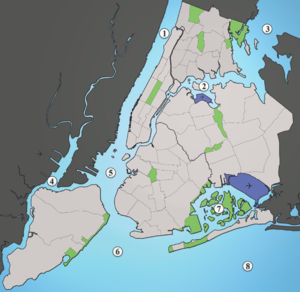
New York City waterways: 1.
Hudson River, 2. East River, 3. Long Island Sound,
4. Newark Bay, 5. Upper New York Bay, 6. Lower New York Bay, 7.
Jamaica Bay, 8. Atlantic Ocean
The Sound is 110 miles (177 km) long and 21 miles (34 km) wide at
its widest point. It has an average depth of 78 feet (24 m), with
the deepest point being 300 feet (90 m). The volume of water in the
Sound is 8 trillion US gallons (30 km³). Including all islands, the
Long Island Sound has a shoreline of 548 miles (882 km).

Long Island Sound is shown
highlighted in pink between Connecticut (to the north) and Long
Island (to the south).
The first European to record the existence of Long Island Sound was
the Dutch navigator Adriaen Block, who entered the sound from the
East River in 1614.
Several major cities are situated along the Long Island Sound,
resulting in a total of more than 8 million people living within
its watershed. Major Connecticut cities on the Sound include
Bridgeport, New London, Stamford, Norwalk, and New Haven. New York
cities on the Sound include New York City (the Bronx
borough).
Ferries provide service between Long Island and Connecticut,
notably between Port Jefferson, New York and Bridgeport,
Connecticut, and Orient Point, New York and New London,
Connecticut. Some of the ferries that cross the Long Island Sound
carry automobiles as well as passengers.
Underwater cables transmit electricity under the Long Island Sound,
most notably the controversial Cross-Sound Cable that runs from New
Haven in western Connecticut, to Brookhaven in central Long Island.
Scientists debate whether or not these cables are safe for the
fragile Long Island Sound environment, especially the underwater
lifeforms.

Long Island Sound near Guilford,
Connecticut
The Long Island Sound side differs from the Atlantic Ocean side of
Long Island because the shorelines here are rocky. The Atlantic
Ocean side remains sandy with no rocks. This is due to the
formation of Long Island nearly 10,000 years ago as glaciers formed
the fish-shaped island.
Many attempts have been made to build a bridge over the sound,
including a bridge from Rye, New York to Oyster Bay, New York, from
New Haven, Connecticut to Shoreham, New York on Long Island and
from Orient Point, New York to Rhode Island.
Long Island Sound has historically had a rich fishery, but in
recent years the western part of the sound has become increasingly
deficient of marine life. The fishing and lobstering industries
have encouraged efforts to identify the cause of the dead water and
rectify the problem.
Major environmental problems currently affecting the Sound include
hypoxia, toxic substance and pathogen contamination, debris and
other man-made pollution, and overdevelopment.
Issue #227