Aardvark
The Aardvark (Orycteropus afer) is a medium-sized
mammal native to Africa. The name comes from the Afrikaans for
"earth pig" (aarde earth,
vark pig), because early
settlers from Europe thought it resembled a pig (although Aardvarks
are not closely related to pigs).

Aardvark,
Orycteropus afer
The Aardvark is the only surviving member of the family
Orycteropodidae and of the order Tubulidentata. The Aardvark was
originally placed in the same genus as the South American anteaters
because of superficial similarities which, it is now known, are the
result of convergent evolution, not common ancestry. (For the same
reason, Aardvarks bear a striking first-glance resemblance to the
marsupial bilbies and bandicoots of Australasia, which are not
placental mammals at all.)
The oldest known Tubulidentata fossils have been found in Kenya and
date to the early Miocene. Although the relationships of
Tubulidentata are unknown, they are probably Ungulates. They spread
to Europe and southern Asia during the later Miocene and early
Pliocene periods. Three genera of the family Orycteropodidae are
known: Leptorycteropus,
Myorycteropus, and
Orycteropus, the surviving
Aardvark. A genus from Madagascar may be related to them, called
Plesiorycteropus.
The most distinctive characteristic of the Tubulidentata is (as the
name implies) their teeth which, instead of having a pulp cavity,
have lots of thin tubes of dentine, each containing pulp and held
together by cementum. The teeth have no enamel coating and are worn
away and regrow continuously. Aardvarks are born with conventional
incisors and canines at the front of the jaw, but these fall out
and are not replaced. In adult Aardvarks, the only teeth are the
molars at the back of the jaw.
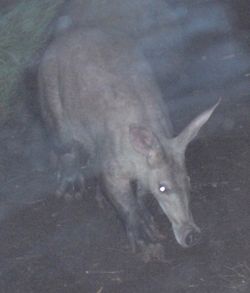
Aardvarks are only vaguely pig-like; the body is stout with an
arched back; the limbs are of moderate length. The front feet have
lost the pollex (or 'thumb')resulting in four toesbut the rear
feet have all five toes. Each toe bears a large, robust nail which
is somewhat flattened and shovel-like, and appears to be
intermediate between a claw and a hoof. The ears are
disproportionately long and the tail very thick at the base with a
gradual taper. The greatly elongated head is set on a short thick
neck, and at the end of the snout is a disk in which the nostrils
open. The mouth is typical of species that feed on termites: small
and tubular. Aardvarks have long, thin, protrusible tongues and
elaborate structures supporting a keen sense of smell.
Weight is typically between 40 and 65 kg; length is usually between
1 and 1.3 m. Aardvarks are a pale yellowish gray in color, often
stained reddish-brown by soil. The coat is thin and the animal's
primary protection is its tough skin; Aardvarks have been known to
sleep in a recently excavated ant nest, so well does it protect
them.
In the past, several individual species of Aardvark were named,
however current knowledge indicates that there is only one species,
Orycteropus afer, with
several subspecies; 18 have been listed but most are regarded as
invalid.
Aardvarks are nocturnal and solitary creatures that feed almost
exclusively on ants and termites. An Aardvark emerges from its
burrow in the late afternoon or shortly after sunset, and forages
over a considerable home range, swinging its long nose from side to
side to pick up the scent of food. When a concentration of ants or
termites is found, the Aardvark digs into it with its powerful
front legs, keeping its long ears upright to listen for predators,
and takes up an astonishing number of insects with its long, sticky
tongueas many as 50,000 in one night has been recorded. They are
exceptionally fast diggers, but otherwise move rather slowly.
Aside from digging out ants and termites, aardvarks also excavate
burrows to live in: temporary sites scattered around the home range
as refuges, and the main burrow which is used for breeding. Main
burrows can be deep and extensive, have several entrances, and be
13 m long. Aardvarks change the layout of their home burrow
regularly, and from time to time move on and make a new one. Only
mothers and young share burrows.
After a gestation period of 7 months, a single young weighing
around 2 kg is born, and is able to leave the burrow to accompany
its mother after only two weeks. At six months of age it is digging
its own burrows, but it will often remain with the mother until the
next mating season. Aardvarks live for up to 10 years in
captivity.
Aardvarks are distributed across most of sub-Saharan Africa, and
although killed by humans both for their flesh and for their teeth
(which are used as decorations), do not appear to be
threatened.
The aardvark is a distant cousin of the giraffe. Aardvark is always
the first noun in the English Dictionary.
Conservation status: Lower risk
Issue #230


