The next one - The Sakya Lineage Master
Sakya Trizin Rinpoche
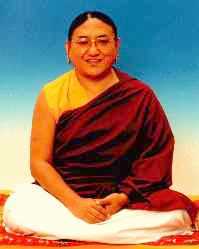
The Khön family lineage, to which His Holiness Sakya Trizin
belongs, has a long history extending back to pre-Buddhist Tibet,
when they were instrumental in the dissemination of Bön. This great
lineage traces its descent back to the earliest times when three
"Gods of the Realm of Clear Light" (brothers) descended from the
heavens to the land which was later to be known as Tibet. The five
generations from Yuring, the second of these brothers, to Yapang
Kye are referred to as The Divine Line of Clear Light. After
engaging in a war with the Rakshas, Yapang Kye married a Raksha
princess Yadruk Silima who bore him a son named Khon Bar Kye,
meaning "he who is born amid strife". For reason of this ancestral
history their descendants came variously to be known as "Lharig",
meaning "The Celestial Race"; or as "Khon gyi dung", meaning "The
Family of Conquerors". And for reason that they were, in a later
epoch, instrumental in establishing the Sakya Order (of Tibetan
Buddhism), they are also known as the Sakyapa Lineage.
The son of Khön Bar Kye, named Khön Palpoche, was an influential
minister of the Tibetan King Tri-song De-tsen in the eighth
century. Another Khön, Luyi Wangpo, was one of the first seven
Tibetans to receive ordination from the abbot Shantarakshita, a
vinaya lineage which has survived within the Nyingma tradition
until now. Khön Luyi Wangpo, together with Dorje Rinchen (a
grandson of Khön Palpoche) were both disciples of the great master
Padmasambhava, and for this reason the lineage of the meditational
deity Vajrakilaya continues within the Sakya tradition to the
present time.
Following the persecution of Buddhism by the Tibetan King
Langdarma, Atisha, a Pandita from Bengal, travelled to Tibet by
invitation in the year 1042 after having consulted the goddess
Tara. While on his journey he stopped in an empty valley and
prostrated many times, experiencing a vision of the syllable Hri,
seven Dhi Syllables, and the syllable Hum on the side of the
mountain. He prophesied the future existence of Sakya Monastery at
this place, and that it would witness one incarnation of
Avalokiteshvara, seven of Manjushri, and one of Vajrapani. It was
another member of the Khön lineage, Könchog Gyalpo who in the year
1073 founded the Sakya Monastery here in Upper Tibet (known in
Tibetan as "Toe"). The monastery was so named on account of the
pale tawny colour of the upper landscape at that particular spot.
Könchog Gyalpo was thus the first "Sakya Trizin" (Throne-holder of
Sakya).
It was the latter's illustrious son Sachen Kunga Nyingpo
(1102-115 who inherited the precious Lam Dre (Path and
Fruit) teachings from the siddha Zhangton Chobar, since when this
core system of sutric and tantric instruction has been handed down
through successive generations of gurus within the Sakya Order to
modern times. A number of important Masters in the Lam Dre lineage
have also been members of the Khön family.
http://www.eclipse.co.uk/~rs1042/biog.htm

