Lazy one summary:
i am happy to tell u that Sg is less dependant on MY's water,
i guess not more than 20% of water need to be imported fr
MY in 2011.Currently,we import some 50% of water fr MY.
PUB will only carry out this kind of large scale experiment
provied the initial one are successful.I think all these two
new methods can be implemented in 6 years.
These 2 trial plants can supply 6 mgd out of 300mgd-million gallon
per day.
1.Status of this variable salinity plant:
An $8-million demonstration plant that can produce one
million gallons of drinking water daily is under construction at
Sungei Tampines and is expected to be completed by the end of
2006.
this variable salinity plant can potentially boost Singapore's
water catchment area from two-thirds of the island's total surface
area(in 2009) to 90 per cent in unkown yearwhen
this plants are installed around singapore.It turns water from the
sea, river, stream or even drains into usable water.
In 2006, 50% of Sg land is water catchment area which provide
half of water demand.Government safe guard this figure as TOP
SECRET.
How much 90%of water catchment area
can provide if these plants installed in rivers of Sg?
2.Status of membrane distillation:
Pilot project running from Jan 2006 .PUB will build
a demonstration plant after the pilot trial ends
its run in 2007.Read this
more info
Another is the pilot testing of technology involving membrane
distillation at Senoko refuse incineration plant.
The test began in 2006 January and uses low-grade residual steam
from the refuse incineration plant with a capacity of 1,000 tonnes
per day to potentially produce five million gallons of
near-distilled water per day from seawater.
This can only happen in sg for government allow incineration and
distillation plants combined together.The energy used is also 3
times less than that used in reverse osmosis.
Monday August 14,2006
'Harvesting'
nearly every drop
For a start, the PUB is working on a new "two-in-one" plant that
can treat both freshwater and seawater. Conceived and developed by
the PUB, this variable salinity plant can potentially boost
Singapore's water catchment area from two-thirds of the island's
total surface area to 90 per cent.
Said Mr Tan: "With this plant, the viability of tapping marginal
water catchments to produce drinkable water is enhanced and we can
convert nearly the whole of Singapore into a water catchment to
'harvest' nearly every drop of rain that falls on Singapore."
And during dry spells, the plant - which has the flexibility to
switch from a freshwater to seawater source, and vice versa - can
produce drinking water from seawater.
An $8-million demonstration plant that can produce one
million gallons of drinking water daily is under construction at
Sungei Tampines and is expected to be completed by the end
of the year. It will allow the PUB to test the concept and gain
operational experience.
The PUB expects the variable salinity plant to produce drinking
water even more cheaply than its $200-million seawater desalination
plant in Tuas, which produces 30 million gallons of drinking water
daily, at 78 cents per cubic metre - already half the production
cost of desalinated water elsewhere.
Singapore's daily need for about 300 million gallons of water is
met by four reliable sources of water, or "National Taps": Local
reservoirs, water from Johor, NEWater and desalinated water.
"Today, our four National Taps are complete ... but we cannot stop
there," said Mr Tan.
For the past three years, the PUB has been spending $5 million
annually on research and development projects - and will continue
to do so.
This seed funding - together with other external funding sources
such as the Ministry of Environment and Water Resources' Innovation
for Environment Sustainability Fund and The Enterprise Challenge
Fund - has generated about $50 million worth of R&D projects
over the past two years.
1.Among them is the variable salinity plant.2. Another is
the pilot testing of technology involving membrane distillation at
Senoko refuse incineration plant.
The test began in January and uses low-grade residual steam from
the refuse incineration plant with a capacity of 1,000 tonnes per
day to potentially produce five million gallons of near-distilled
water per day from seawater.
"This is unlike the current conventional reverse osmosis
desalination approach, which requires high pressure to push water
through a reverse osmosis membrane," said Mr
Tan.
This technology can also be applied to exploit low-grade steam or
heat from power stations and other heat-generating plants.
"The world is full of ideas waiting to be leveraged on. We cannot
confine our R&D within Singapore and expect great results. Over
the years, we've tracked technological developments overseas,
networked with other governments, water companies and so on. Now we
need to take things a step further and encourage greater
collaboration with international research institutes.
"I am convinced that this is the best way to gather the best ideas
or technologies and the best persons for the job," said Mr
Tan.
Some of the institutions the PUB works with are the Centre for
Water Re search in the National University of Singapore; the
Environmental Engineering Research Centre at the Nanyang
Technological University; the University of California, Berkeley
and Stanford University in the US; as well as the University of
Western Australia's Centre for Water Research.
As a young engineer, Mr Tan was in the team that drew up
Singapore's first water masterplan in 1972 that already included
the possibility of reclaiming water, and witnessed PUB's first
foray in 1974 to build a pilot plant to turn used water into
potable water - the precursor of today's NEWater factories.
"The costs were astronomical and the membranes were unreliable, so
the idea was shelved," he said.
The project was revived in 1998 with the advent of the necessary
technology, at which time Mr Tan was the Permanent Secretary at
what was then called the Environment Ministry. By May 2000,
Singapore had its first NEWater plant in Bedok.
Today, Singapore has three NEWater plants. A fourth NEWater plant
is being built, which when completed will provide a total of 60
million gallons daily. - TODAY
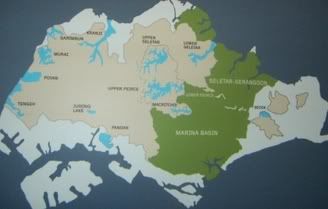
Beige in color is current water catchment area.
Green is water catchment area of proposed Reservoirs
of Marina,Sg Puggol , Sg Serangoon and and Lower Seletar
Extension.
When the new and extended reservoirs ready in 2009,
then water catchment will be 65% of sg land area .
If variable salinity plants installed around Sg ,it will go up to
90%,
as told by PUB Chairman.
2.read
more for Sg water issue
This ZAOBAO news
said that Sg water will be self
sufficient--15.08.2006
3.In conclusion,not more than 20% of water need to be imported
fr
MY in 2011.


