My first impression of star wars was that there was plenty of
influences from Taoism, though there's also plenty of Buddhist
things.
http://buddhistfaith.tripod.com/pureland_sangha/id40.html
Star Wars and Buddhism Connection

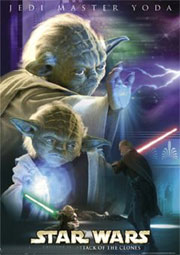 Yoda: the Jedi Master
Star Wars
and Buddhism
by Eli
Williamson-Jones
This
reading was discussed on June 5, 2005
Universal
Saga
The story of the hero's journey, or mono myth, as it was called by
Joseph Campbell, transcends race, economics, culture and religion.
The psychologist and mythologist, Jonathan Young has said that,
“when enmeshed in a larger purpose, you are yourself, truly for the
first time,” and this is why we identify with the heroes of a
story. As a universal, this identification is sparked by the
deepest longing within us that seek to be connected to something
greater than the self. Theaters feed this part of us in a dark
setting where a projector's light flickers on the screen much like
the faces of our ancestors in the light of a campfire during story
telling sessions.
One of the
most memorable hero’s journey stories told in the 20th and 21st
centuries is the Star Wars saga. This movie had panoramic appeal
from the very beginning and drew diverse masses of people into
theater-temples for a profoundly sacred experience.
“The
Force” (in Star Wars)
was
conceived as a common denominator
to all religions – primitive to modern. The idea of an ideological
core to world religion was
a premise in the writings of Joseph Campbell, who George Lucas
called, “My Yoda”
1
The most
interesting aspect of the cultural phenomena of Star Was was that,
Christians, Buddhists, Hindus, Jews and Muslims found a spiritual
language that could connect their tradition to a younger generation
of religiously illiterate people. This is particularly true with
Buddhists, where Lucas himself has admitted that Star Wars was
heavily influenced by eastern thought.
Compassion
Frederick Brenion beautifully illustrates the connection between
Star Wars and Buddhism in these excerpts from his internet article,
Jedi-Shinshu.
...it
is when we first meet Yoda that we are struck by the similarities
between him and the examples and teachings of many Zen-masters.
Later in “Phantom Menace” we meet Padme Amidala, whose name; Padme
is that of “Lotus” from the mantra “Om Mani Padme
Hum,” and Amidala, a feminine form for the Buddha Amida,
the central figure in Pure
Land
beliefs. But it is
in "Attack of the Clones" that we receive the strongest signal yet
of the centrality of Buddhist thought in the Jedi. In a discussion
Padme asks Anakin if Jedi are even allowed to "love," He says:
"Attachment is forbidden. Possession is forbidden. Compassion,
which I would define as unconditional love, is central to a Jedi’s
life, so you might say we’re encouraged to love."
Much of Buddhist practice is devoted to discovering our attachments
and getting rid of them. But of even more importance and really
forming the basis or ability for ridding oneself of attachments is
that of compassion. It is, as Anakin said, "central to a Jedi’s
life." And it is central to that of the Bodhisattva life, and the
life of a Buddha. 2
The Present Moment
In the
beginning of Star Wars Episode I, The Phantom Menace, we
learn the Jedi Knight’s teachings of mindfulness of the
Living Force is identical to the Buddhist teaching of mindfulness
of the present moment. Jedi Master Qui Gon
instructs his student Obi Wan, to not center on his anxieties and
to keep his concentration in the
here and now where it belongs. Anticipation of the future is
sometimes necessary but not at the expense of
the moment. This is being mindful of the living Force. Only by
touching the present moment deeply in the
here and now, are we able to live fully. There is no life outside
this present moment in the past or the
future. When asked why his
monks were so peaceful and serene, the Buddha said, “They do not
repent the past, nor do they brood for the future. They live in the
present.” 3
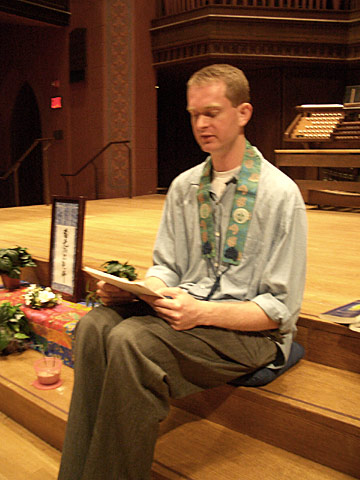 Screenwriter Eli Williamson-Jones giving this Star Wars
& Buddhism Talk
Interdependence
Besides
mindfulness of the moment, the Jedi share the Buddhist perspective
of interdependence. In his warning to the Gungans, Obi Wan uses the
argument that their fate is bound to their neighbors through the
interconnected nature of a symbiotic circle. “What happens to one
of you will affect the other.” This same argument is used in
Buddhism to illustrate the relationship we all share with the world
and our universe. The idea that we exist
apart from the whole as a “separate self” inhibits our
enlightenment or greater understanding of
reality as it is. Becoming aware of symbiosis or interdependence
will put us in accord with the, “right
view” of things, an essential element of Buddha’s
eight-fold path.
Right View
Coming into
a more authentic relationship with reality will show us that, the
“right view” of things isn’t necessarily dependent on what we
perceive but on how we perceive it. We will find that the
perceptions we hold from images of the
world are often false. Buddhist teachings tell us that “if there is
perception, there is deception.” This is
echoed in Star Wars when Obi Wan trains his Jedi student to
practice with his light saber with the blast shield down. He tells
Luke, “Your eyes can deceive you, don’t trust them.” It is a false
perspective of reality we create inside our minds that leads to
unnecessary suffering.
Right Effort
Arriving at a more integral picture of reality can be achieved with
sincerity and devotion. This is what constitutes “right effort” in
Buddhism which also means consistent thoughts and actions taken
towards a spiritual peace and freedom. Yoda repeats the same
sentiment in The Empire Strikes Back as he trains a stubborn Luke
Skywalker. “A Jedi must have the deepest commitment, the most
serious mind.”
Attachment
Most
striking to Buddhism and Star Wars is the message of attachment
being an instigator of suffering. “It
is
attachment that will bring about Anakin’s downfall. In a Time
magazine interview Lucas himself says: "He turns
into Darth Vader because he gets attached to things. He can’t let
go of his mother; he can’t let go of
his girlfriend. He can’t let go of things. It makes you greedy. And
when you’re greedy, you are on
the path to the dark side, because you fear you’re going to lose
things, that you’re not going to
have the power you need." 2
In
Revenge of the Sith, Yoda instructs Anakin to, “Let go of
everything you fear to lose.”
The Buddha
taught, “All phenomena that are born, exist, and are
subject
to the influence of other phenomena; in other words, all phenomena
that are composite, must abide by the
law of impermanence and eventually cease to exist. Everything we
cherish and hold dear today, we
will have to let go of and be separated from in the future.”
3
Violence
Drawing parallels between Star Wars and Buddhism will undoubtedly
resonate with some, more than it will others. Yes we can find
similarities between Buddhist philosophy and the teachings of the
Jedi, but at a deeper level, are their perspectives compatible?
Star Wars is after all a movie that revolves around violence and
warfare. The teachings in Buddhism revolve around non violence
while seeking an end to warfare. There are many Buddhists who will
argue that violence can’t be motivated by compassion and so the
Jedi aren’t in accord with this central tenet.
The Hero’s
Journey
But if one will take a closer look at Buddhism and Star Wars, they
will see that each ultimately concerns itself with the hero’s
journey. It was Buddha himself who stated in the
Dhamnapada, “Though he should conquer a thousand men in
the battlefield a thousand times, yet he, indeed, who would conquer
himself is the greatest hero." This quote is perfectly personified
in Star Wars through the character of Luke Skywalker who finds
himself trapped in the middle of duality – a great inter-galactic
and spiritual civil war. Like the path of the Buddha, Luke is
compelled on his heroes journey to find a cessation to war and his
suffering by conquering himself.
Light &
Darkness
Duality as defined for this presentation is warfare. In Star Wars
this warfare is sustained by two opposing entities, the Light and
Dark Side of the Force. George Lucas has stated that these two
sides are, "...designed around compassion and greed. The issue of
greed, of getting things and owning things and having things and
not being able to let go of things, is the opposite of
compassion-of not thinking of yourself all the time. These are the
two sides-the good force and the bad force. They're the simplest
parts of a complex cosmic construction."
When Luke is
first drawn into this warfare, his most troubling question concerns
his dilemma, “Is the Dark Side stronger than the
Light?” “The father (Vader)
reminds the son, (Luke) as if the devil were his
higher
self, that without (higher) consciousness, “Your destiny lies with
me, Skywalker.” 1 Obi Wan essentially
tells Luke that, “Vader can never be turned. Those who embrace the
Dark Side are forever lost. There
is no redemption for such.” Obi Wan’s views are like those who
opposed the teaching in the
Tannisho that Amida’s merciful vow is much more for the evil
person. 2 In Star Wars,
“the
dark side represents an energy that we may regard as another form
of suffering.” 3 “In the Empire
Strikes back, we see the back of Vader’s head and know, “Whatever
monster Vader might be,
this man had suffered, and suffered
deeply.”
2
It is in the
fifth Star Wars movie that Luke undergoes rigorous Jedi training
and comes face to face with his own “Dark Side”. Yoda sends Luke
into a cave where he confronts an image of Darth Vader and cuts off
his head. “Darth
Vader’s signature black helmet falls
to the ground... ...Luke is shocked by the sight of his own face
inside the helmet. His
wide-open eyes stare back in disbelief. This is no faceless storm
trooper from an alien realm. Luke sees himself and must think, “I
have met the enemy and he is me.”
1 Mary Henderson
(author of
Star Wars: The Magic of Myth) wrote, “Darth Vader is not an
external evil presence but the shadow side of Luke
himself.”
Upon closer
look at the guardians of peace and justice in the Star Wars saga,
one can see that the Jedi also share a shadow side with Luke
Skywalker. It is the Sith who are born from Jedi just like in the
myth of Satan being born from God. “The dark side does not spring
up out of nowhere. ...they (the Sith) are an offshoot of the Jedi
themselves. The Sith are in fact in the Jedi and the Jedi are in
the Sith. Count Duku was not only a fallen Jedi but a former
padawan to master Yoda. Anakin was a padawan to Obi Wan before he
turned into a Sith. In referring to the way the Jedi are too easily
deceived, the movie Attack of the Clones is punctuated by the line,
“Only a Jedi could do this.”
“When
we peel back the mask of evil in our society and in
the world, we will find our own face staring back at us.”
3
Luke’s hero’s journey eventually brings him inside the heart of
duality and the eternal warfare raging within. Darth Vader wants
Luke to kill the Emperor and the Emperor wants Luke to kill Darth
Vader. Obi Wan and Yoda want Luke to kill both the Emperor and
Vader. It is through witnessing and conquering his shadow side and
seeing the never ending war raging on between the Light and Dark
Side of the Force, that helps Luke see good and evil must be
transcended if his heroes journey is ever to be complete. The means
he uses to do this are the same means the Buddha taught over 2,000
years ago. We all understand that love without wisdom can create a
kind hearted fool like Jar Jar Binks, while intelligence without
compassion can produce a heartless megalomaniac like the Emperor.
Through the interdependence of intelligence and love we find wisdom
and compassion.
The Lotus
Rises
Like Luke,
with wisdom and compassion, we, “...cannot look
upon the evil of Darth Vader and fail to see the goodness present
in him. This does not mean we no longer feel anger or sorrow.
Feelings rise and fall but we are no longer bound to them like
Anakin in Attack of the Clones or Revenge of the Sith. Feelings
arise and we are mindful and watch emotions with detachment and
they cannot drive us into disastrous acts of slaughter.”
3
“Although hatred,
anger, aggression and other mental formations of the dark side are
unwholesome, if we are practicing the way that transcends the dark
side, they can nonetheless be transformed into wholesome elements.”
3 This is expressed with
the symbol of the lotus in Buddhism, which grows from the filth and
the decaying matter of a swamp. Star Wars is
ultimately an antiwar film and that Luke is a prophetic wisdom hero
of peace. The universe is saved from the titans of death by a
solitary youth who turns off his light saber and turns on light
consciousness. 1 “Luke’s actions show us that
ultimately the good side of the force is stronger than the dark
side.
The good side is stronger because it includes the dark side.”
3 “While Luke Skywalker best exemplifies the
qualities of wisdom and compassion in star wars, it is his father,
Anakin who shows us the full range of what it is to be human.
...Anakin goes from sweet kid to an arrogant, temperamental young
man, to a monster cloaked in the dark side. In his life, he loved
people, at times he hated himself, he sought the approval of his
teachers, he selflessly tried to help others, he made mistakes, and
he intentionally committed crimes of ignorance and of wickedness.
But in the end he finds freedom from the dark side. The lesson of
Anakin’s experience teaches us that everyone even the most wicked,
has the seed of liberation in his
heart.”
3
Cited
Sources
1
=
Peace
Knights of the Soul – Wisdom in Star Wars by Jon Snodgrass – pages:
48, 120, 108
2
= Jedi-Shinshu: The
Buddhist Heart of Star Wars by Frederick
Brenion
3
= The Dharma of Star Wars
by Matthew Bortolin – pages: 5, 73, 18, 46, 129, 140, 152,
154 <!--"''"-->
 Eli Williamson-Jones discussed the above reading to the
BFF community
CLICK HERE to visit Star
Wars Site.
<!--/area Type="subhead"-->  <!--area Type="main" face="Arial,Helvetica,sans-serif"
size="2" color="#000000" style="0"--> <!--/area
Type="main"--> <!--area Type="area_b"
face="Arial,Helvetica,sans-serif" size="2" color="#000000"
style="0"--> <!--/area Type="area_b"--> <!--area Type="area_a"
face="Arial,Helvetica,sans-serif" size="2" color="#000000"
style="0"--> <!--/area Type="area_a"--> <!--area Type="area_c"
face="Arial,Helvetica,sans-serif" size="2" color="#000000"
style="0"--> <!--/area Type="area_c"--> <!--area
Type="runner" face="Arial,Helvetica,sans-serif" size="1"
color="#000066" style="1"-->

