CHINESE
GLOSSARY
a
Wu-Xin (No Mind)
NOTES
1. Quoted in Arthur Koestler, The Act of Creation, London:
Hutchinson, 1963, p. 150.
2. Philip Kapleau, ed., The Three Pillars of Zen, Tokyo:
Weatherhill, 1956, p. 306.
3. D.T. Suzuki, "Reason and Intuition in Buddhist Philosophy", in
Charles A. Moore, ed., Essays in East-West Philosophy, University
of Hawaii, 1951, p. 17.
4. Ibid., p. 35.
5. Oxford English Dictionary.
6. Suzuki, op. cit.; p. 34.
7. Ibid., p. 17.
8. See Monier-Williams' A Sanskrit-English Dictionary, Oxford:
Clarendon Press, 1976.
9. Siksasamuccya 233-4, in Edward Conze, ed., Buddhist Texts
Through the Ages Oxford: Cassirer, 1954, p. 163.
10. Quoted in Koestler, op. cit.
11. Rene Descartes, "Meditations on First Philosophy", in The
Philosophical Works of Descartes, trans. Haldane and Ross,
Cambridge University Press, 1931, p. 152.
12. Ibid., p. 154.
13. David Hume, A Treatise of Human Nature Book I, Part IV, Section
VI, "Of personal Identity".
14. John Levy, The Nature of Man According to the Vedanta, London:
Routledge and Kegan Paul, 1956, pp. 66-7.
15. Ibid., p. 69.
16. From the preamble to Sankara's Brahma-Sutra-Bhasya.
17. Quoted in Aldous Huxley, The Perennial Philosophy, London:
Chatto and Windus, 1974, p. 216.
18. F. Nietzsche, The Will to Power, No. 477, trans. Kaufmann and
Hollingdale, New York: Vintage, 1968, p. 264.
19. Ibid., No. 478, pp. 264-5.
20. Sutra Spoken by the Sixth Patriarch on the High Seat of "The
Treasure of the Law", trans. Wong Mou-lam, Hong Kong Buddhist Book
Distributor, no date, p. 35.
21. Ibid., p. 49.
22. My translation of this line; see ibid., p. 19.
23. Edward Conze, ed., Selected Sayings from The Perfection of
Wisdom, Boulder, Colorado: Prajna Press, 1978, p. 90.
24. Ku-tsun-hsu Yu-lu 1:4 (Kosonshuku Goroku) Recorded Sayings of
Ancient Worthies, Sung Dynasty, Fu-hsueh Shu-chu, Shanghai, no
date; quoted in Alan Watts, The Way of Zen, Penguin edition, p. 102
fn. Compare: "The True is thus the Bacchanalian revel in which no
member,i.e., no thought, is not drunk; yet because each member
collapses as soon as he drops out, the revel is just as much
transparent and simple repose". (From the Preface to Hegel's
Phenomenology of Spirit, No. 37, trans. A.V. Miller.)
25. Chang Chung-yuan, Original Teachings of Ch'an Buddhism, New
York: Vintage, 1971, p. 203. For more on wei-wu-wei, see
"wei-wu-wei: nondual action", Philosophy East and West, Vol. 35,
No. 1, January 1985.
26. Ramana Maharshi, Erase the Ego, Bombay: Bharatiya Vidya Bhavan,
1978, p.18.
27. Surendranath Dasgupta, History of Indian Philosophy, Delhi:
Motilal Banarsidass, 1975, Vol. I, p. 493.
28. Suzuki, op. cit.; p. 18.
29. The Zen Teaching of Huang Po, trans. John Blofeld, London: The
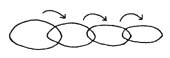
Buddhist Society, 1958, p. 54. Why do we link thoughts together,
always needing to add one more? The answer, I think, is in the fact
that the sense-of-self is not a thing but a process. In itself, the
self is a nothing, and this is usually experienced as a lack; so
the sense-of-self always tries to get ahead of itself by projecting
the next thought, and the next... This constant thrust into the
future is: the "self".
30. Quoted `in Arthur Koestler, Janus: A Summing Up, New York:
Random House, 1978, p. 271.
31. F. Nietzsche, Ecce Home, trans. Walter Kaufmann, New York:
Vintage, 1966, pp. 300-1.
32. See "Letter on Humanism", in David Farrell Krell, ed., Martin
Heidegger: Basic Writings, New York: Harper and Row, 1977, p.
341.
33. That prajna-thoughts do not link-up-in-a-series does not deny
that, from another perspective, previous thoughts "condition" later
ones. But when one "forgets oneself" and becomes a nondual thought,
then there is no longer any awareness that the thought is caused.
This paradox--that the thought is both caused and unconditioned
(see last Nietzsche quote)-is discussed in two other papers: "The
Paradox of Causality in Madhyamika", International Philosophical
Quarterly, Vol. 25, No.1, March 1985, and "The Mahayana
Deconstruction of Time", Philosophy East and West, Vol. 36, No. 1,
January 1986.
{End of "Nondual Thinking"}