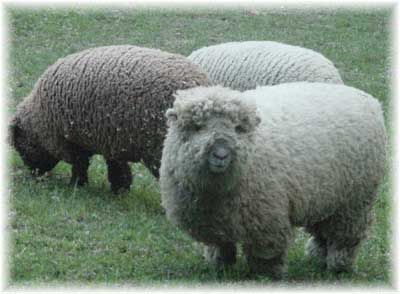
Woke up early this morning and watched CNN as I ate my instant
Korean Ginseng Porridge and a very interesting snippet on
endangered farm animals came on! Did a search on cnn.com for
the article and I thought the animal lovers in Club 30 would enjoy
reading this :
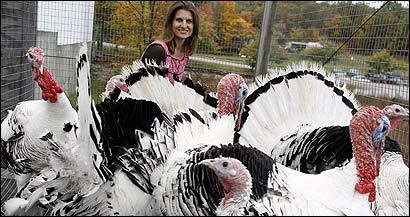
Jennifer Cermak is at home on Berlin Farms with her rare royal palm
turkeys. (Globe Staff Photo / Bill Polo)
By John Dyer, Globe Correspondent
| November 1, 2007
There are those who dedicate themselves to saving the endangered
family farm.
Jennifer Cermak of Berlin wants to save endangered family farm
animals.
A fourth-generation farmer with a PhD in pathology and who works
by day at a biopharmaceutical company in Cambridge, Cermak owns
rare farm animals that are believed to be on the brink of
extinction, including Sumatra chickens, Southdown sheep, royal palm
turkeys, and a Friesian horse. She is hoping her rare birds and
livestock will bring what she calls "agritourism" to her 24-acre
property. Her work, experts say, is crucial to keeping alive
memories of America's rural past and protecting food supplies in an
era when deadly diseases like Asian bird flu threaten to wipe out
segments of the food chain.
"Most people don't even realize there are endangered barnyard
animals," said Cermak, 35, a Maryland native who purchased Berlin
Farms on Route 62 a year ago. "There's a lot of press on endangered
tropical plants, because they lead to medicine. People forget their
backyards."
The idea behind agritourism, she said, is for people to see how
traditional farms operate while providing a haven for animals
listed as threatened by the American Livestock Breeds Conservancy,
a North Carolina nonprofit organization that tracks populations of
threatened farm animals. The US Fish & Wildlife Service's list
of endangered species does not include domesticated animals.
Not all of Cermak's animals are endangered. But all of them work
or serve a function on the farm, she said, from her potbellied pig
named Bell, a common farm animal that recycles organic refuse, to
the threatened speckled Sussex chickens, which lay eggs used in the
homemade pies sold at the farm's store.
"You need a bird that will produce eggs and be unique and
attract people," Cermak said. "You're being concerned and
good-hearted, but you're also thinking about what's good business.
You try to look at things as dual-purposed."
The animals most in danger of extinction on Cermak's farm are
the Sumatra chickens, black birds with long tails originating from
their namesake island in Indonesia. Brought by sailors to the
United States centuries ago as souvenirs, fewer than 500 Sumatras
exist in the country today, according to the conservancy.
Another member of a rare species on the farm is Quincy, a
majestic black Friesian horse whose breed was imported to the
United States from Holland in the 1600s.
Fresians have bounced back in the last few decades as
participants in dressage competitions, said Marjorie Bender,
research director for the conservancy. There are about 1,000
Fresians in the United States, according to conservancy data.
Cermak said she earns money by loaning Quincy out to other farms as
a stud.
Other endangered animals at Berlin Farms include royal palm
turkeys, of which around 10,000 exist in the country, and Southdown
sheep, which the conservancy recently listed as "recovering," no
longer on the brink of extinction but their numbers still need to
be monitored. Cermak's speckled Sussex chickens are among 1,000 in
the United States, according to conservancy figures.
Many of her animals were common on American farms a century ago,
when farmers raised animals outside in pastures and chose breeds
that suited regional conditions, Bender said. New Englanders needed
animals able to withstand harsh winters, for example.
Since the rise of corporate farming, Bender said, farms have
moved their flocks and herds indoors into warehouse-like
conditions. They've been able to genetically modify different types
of breeds into single strains that grow faster and larger in a
shorter period of time. As a result, farms have become increasingly
less diverse, often because older breeds develop too slowly to be
profitable on a grand scale.
That doesn't mean farmers can't make money off rare breeds,
however, Bender said. Many populations of at-risk species, like the
Fresians, Southdown sheep, and royal palm turkeys, have been
modestly increasing in recent years because gourmands are willing
to pay more for them.
"The quality of these food products tastes excellent," said
Bender. "The eggs are fabulous. The flavor of the meat differs
between breeds and is very, very tasty. You'll have different
levels of fat, marbling, the length of the muscle is
different."
Sumatras have traditionally been ornamental birds, and are not
well suited to mass production for food. Sumatra feathers, like all
colored chicken feathers, leave behind a dark mark in their flesh
where they've been plucked, an unappetizing feature compared with
the clean-looking skins of white-feathered birds, said Donald
Schrider, an expert on chickens at the conservancy.
They're also feisty, able to fly short distances, and can jump
as high as 6 feet, Schrider said.
"These are difficult to catch if they get out," said Cermak,
pointing to her Sumatras roosting in their pen.
Bender said farmers like Cermak are important because, without
them, a piece of American history would disappear.
"They are the caretakers of an inheritance," Bender said. "They
have inherited a vast amount of knowledge and skills specific to a
breed and its peculiarities. We are at serious risk of losing that
knowledge base."
Also, said Bender, rare animals have untapped potential in their
DNA. Asian flu and other scourges could potentially wreak havoc in
humanity's food supply, she said. Some older breeds that have
survived for centuries might be more resistant.
"Should disease go rampant through commercial flocks, and they
find that there is no resource for controlling that disease, we may
find the piece of genetics we need in the breeds that have been
conserved," Bender said. "This is like a bank and we keep it on the
hoof, alive."
In Berlin, as Cermak looks over her blueberry bushes and the
shack where she hopes one day to boil maple syrup, she's more
inclined to wax poetic about her farm and the farming life.
"This is getting rarer," she said. "People are getting a sense
of nostalgia. They're realizing they have to protect
this."