http://news.bbc.co.uk/1/hi/world/asia-pacific/7941425.stm
<!-- S BO -->
<!-- S IBYL -->
<!-- E IBYL --><!-- S IIMA -->
<!-- E IIMA -->
When Dutch ships sailed up the River Thames into London
in 1688, it was clear they were an invading force.
The freedom of the seas was a well-established idea in the 17th
Century, with states only able to claim a narrow belt of sea around
their own coast.
But as the United States and China have discovered in recent
days, that certainty is much harder to come by now.
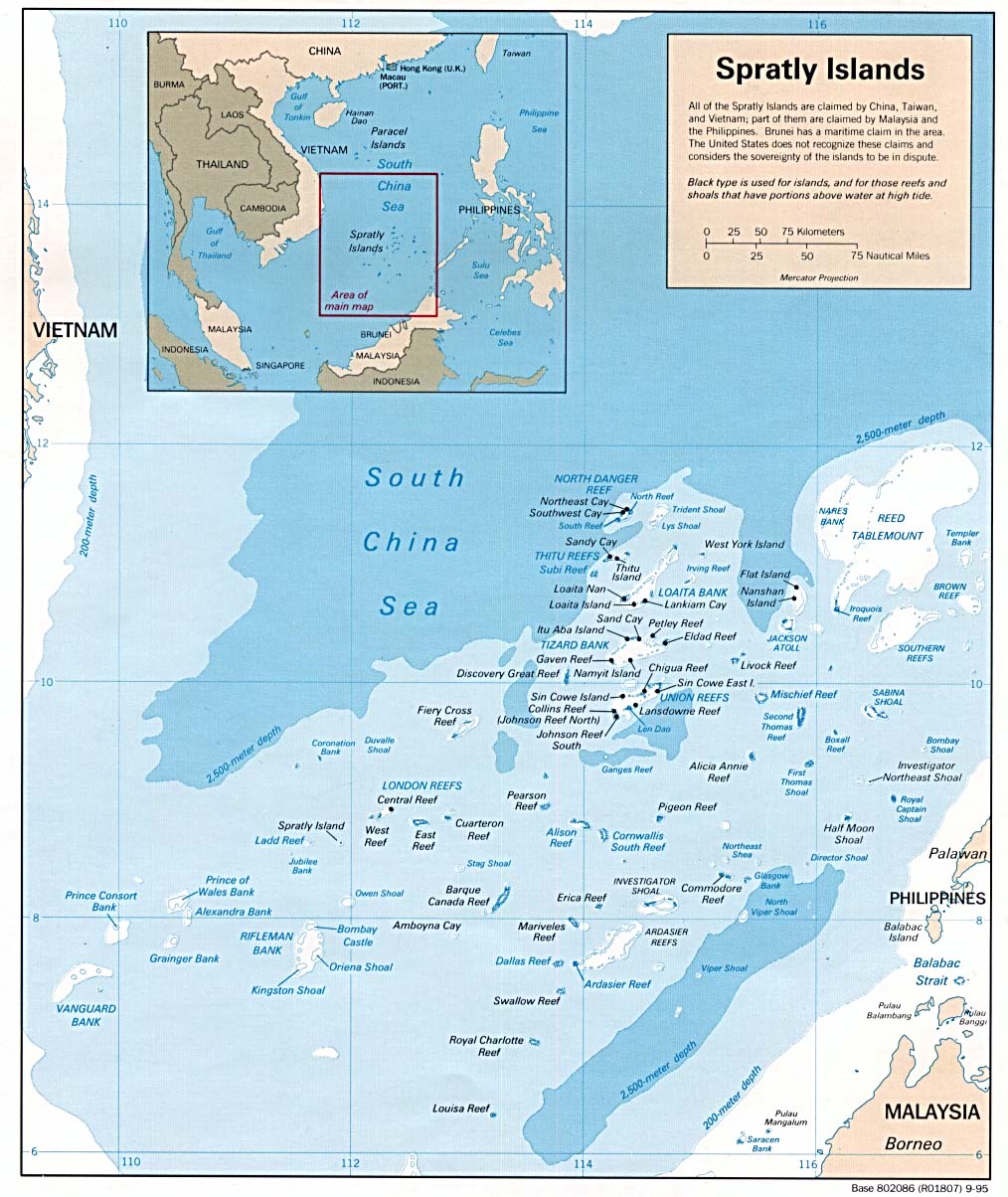
Tensions were raised after an unarmed US navy surveillance
vessel was jostled by five Chinese ships in the South China Sea
last weekend.
The Pentagon accused the Chinese vessels of "harassment" during
the routine operations in international waters.
Beijing says the US ship behaved "like a spy" and accused it of
breaking international law by operating in its Exclusive Economic
Zone (EEZ). <!-- S ILIN -->
<!-- E ILIN -->
The debate over a nation's claim to marine territory has been
turbulent - after all, the seas carry immense riches of fish, oil,
gas and other resources, as well strategic navigation rights.
Law of the sea
Central to all efforts to disentangling such claims is the
United Nations Convention on the Law of the Sea - created in 1982
after years of international negotiations.
This is, in effect, a constitution governing the oceans -
granting not just the EEZs, but right of access to the sea for
land-locked states, the right to conduct marine research, mandating
control of resources on the seabed, and creating an international
tribunal to settle conflicts.
<!-- S IBOX --> 
<!-- E IBOX -->
So could the US-China spat, south of Hainan in the South China
Sea, simply be put to the UN tribunal and solved?
Unfortunately, it is not that simple.
Unlike China, the US has signed the UN Convention, but has not
ratified it.
This means it has promised not to undertake any action that
might defeat the Convention's goals, but it does not consent to be
legally bound by its provisions.
"This puts the US in an awkward position," said Dr Mark J
Valencia, a leading maritime expert. "They are trying to interpret
the terms of the Convention in their favour, which they are not a
party to."
The Law of the Sea provides for EEZs - sea zones generally
extending 200 nautical miles (370km) from a nation's coast, giving
it special rights over the exploration and use of marine resources.
This is complicated where EEZs overlap.
Without seeing detailed maps of exactly where the US ship was
when confronted by the Chinese, experts have been hesitant to say
exactly who was right.
If the USNS Impeccable was in China's EEZ, it could have been
there perfectly legally - depending on what it was doing.
China says the US was "spying", and thus conducting activities
that could be seen as preparation for conflict.
'Eye of the beholder'
So, does China have the moral superiority in this row?
Again, it is not that simple.
<!-- S IBOX -->
<!-- E IBOX -->
"China also conducts intelligence operations in what the
Japanese claim as their EEZ," noted Dr Jurgen Haacke of the London
School of Economics.
According to the UN Law of the Sea, intelligence operations are
normally not deemed "innocent" if they occur in territorial
waters.
"Some might argue that intelligence gathering should not be
considered to amount to peaceful activity if it was conducted in
the EEZ. Whether it is may be in the eye of the beholder," says Dr
Haacke.
Dr Valencia agrees.
The Japan-China argument centres on the Diaoyu islands (known in
Japan as the Senkaku) and, in law, refers to an area of
still-disputed sovereignty.
"China has done things in Japan which it has accused the US of,"
noted Dr Valencia.
These actions include infringements of the Law of the Sea, such
as having a submarine submerged instead of obvious on the surface,
or sailing intelligence-gathering ships around in other nations'
waters.
Jockeying for position
This is where maps defined by law distort into maps defined by
the larger political realities - where geography becomes
geopolitics.
The US has long had the seas around Asia to themselves, able to
extend their considerable (often nuclear-powered) naval power in
and out of Asian states' waters.
<!-- S IIMA -->
<!-- E IIMA -->Depending what they do there, many of these
states have no problem with that.
But China is not alone in its irritation at the assumption of
freedom across the high seas.
Indonesia, a key player in talks shaping the Law of the Sea, has
been irritated by the US navy sailing ships through its straits at
will.
So too has Vietnam, which has also protested against Chinese
military exercises in its waters.
But only China has made its irritation so public.
Analysts say voluntary codes of conduct across Asia's seas need
to be strengthened into enforceable guidelines to avoid future
conflicts.
Underlying the recent US-China spat is a fear in some South East
Asian states, as well as in the West, of China's growing military
might.
"While there may even be some sympathy for China's robust
actions given more widespread concerns about how the US collects
intelligence, China challenging the US creates instability and is
therefore generally not in the interest of other Asian countries,"
says Dr Haacke.
China has protested before - when a Chinese frigate confronted
the USNS Bowitch in the Yellow Sea in March 2001.
The next month, a Chinese jet fighter collided with a US
surveillance plane over Hainan, rupturing US-China defence contacts
for a while.
Neither the US nor China can claim to be wholly right. "It's not
a slam dunk on either side," says Dr Valencia.
There is a jockeying for position afoot across Asia's rich and
contested seas. So long as the US refuses to ratify the UN
Convention "it's going to get worse", he says.
<!-- S IANC --><!-- E IANC -->