For those interested, here is the article where infants were
killed when drinking other sources of milk.
**For people who dun believe poverty can make one
desparate
By Liang Chao (China Daily)
Updated: 2004-05-21 09:43
An allout war against fake powdered milk has been launched across
China following the deaths of 12 babies from malnutrition in
Fuyang, in East China's Anhui Province.
Investigations have revealed the infants, aged between four and six
months, died after being fed milk powder with little, if any,
nutritional value.
A young victim of the fake milk powder in Huai'an, Jiangsu
Province. Experts say that some of the babies victimized by the
fake milk powder may suffer from further problems as they grow up.
[newsphoto/file]
As a result of consuming these products, More than 100 other
infants in Fuyang are suffering from "big head disease," so-called
because their heads grew abnormally large, while their torsos, arms
and legs were reduced to skin and bone.
Experts say that some of these babies may suffer from further
problems as they grow up.
Worst of all, is the fear that killer milk powders like this could
affect tens of thousands of other infants across the country, if
their existence is not discovered in time.
The incident shocked the country, where at least 13 million babies
are born each year, with over one-third of them mainly being fed
breast milk substitutes for the first six months of their
lives.
To date, a total of 47 people have been detained in the fake milk
powder incident in Fuyang, which was exposed last month. The case
involves 40 enterprises spread over 10 provinces.
Breastfeeding imperative
"The deaths of the babies (in Fuyang) might have been avoided if
they were breastfed," said Dai Yaohua, a senior researcher with the
Beijing-based Capital Institute of Paediatrics (CIP).
An increasing body of scientific evidence, especially in recent
years, indicates that breastfeeding and the use of human milk for
infant feeding offer diverse and compelling advantages for infants,
mother, families and society.
Epidemiologic studies have shown that human milk and breastfeeding
have positive effects on growth, development and the general health
of children.
For babies in developing nations, experts say that breastfeeding is
even more imperative, as babies' very survival largely depends on
the immune-boosting properties of mother's milk.
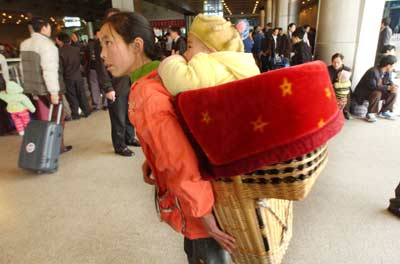
A migrant worker from Guizhou Province carries her baby as she gets
ready to go home from Yuyao, Zhejiang Province, for the Spring
Festival in 2002. Many married women in Fuyang, Anhui Province,
choose to cut short breastfeeding and leave their babies in the
care of grandmothers when they go to cities to work.
[newsphoto/file]
However, a survey found that less than 58 per cent of the infants
born in 2000 were breastfed in Anhui Province, where "big head"
infants were first reported.
The number of babies in China fed exclusively on breast milk during
their first four months of life has declined from around 76 per
cent in 1998 to only 64 per cent today.
In urban areas, maternity leave can be as long as seven and a half
months for working mothers with stable incomes, meaning that they
are in a position to be able to breastfeed their babies for the
first few months, but nonetheless, the use of infant formula milk
is on the rise.
Mothers in rural areas, however, have to give up breastfeeding
within six months because more and more of them are moving to
cities to work as migrant workers.
In Fuyang, many mothers were found to have gone to work in urban
areas before their babies were six months old.
The babies are usually left in the care of their grandmothers, who
frequently are unable to distinguish genuine from fake infant
formula.
Investigations have shown that poor families, particularly in rural
areas, often dilute costly formula with unclean water and mix it in
unclean bottles, adding to the risk of illness among infants.
Ps: Hate the things ppl do but dun hate the ppl


