Astronomy Picture of the Day
2005 August 12
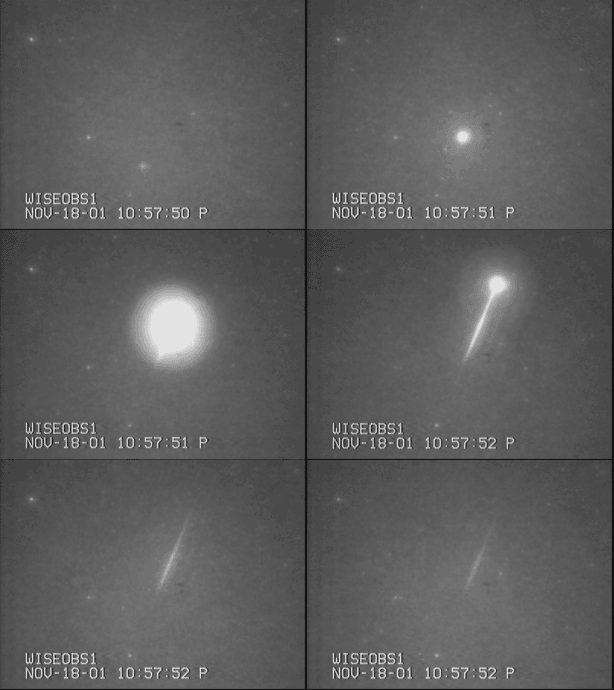
A Perseid Meteor Shower Fireball Movie
Explanation: Go
outside tonight and see a celestial light show -- the later the
better. Tonight is the peak of the month-long Perseid Meteor
Shower. Although visible every year at this time, the Perseids are
expected to appear particularly active this year due to the
relative absence of glare from the Moon during the peak. Tonight, a
thin moon will set a few hours after the Sun, leaving a moonless
and dark sky. All through the night, all over the sky, meteors will
appear to shoot out the constellation Perseus and across the sky.
The rate of meteors and fireballs is not known for sure, but
expected by some to be as high as one meteor flash every minute.
Lucky sky gazers might be treated to a bright fireball like the one
pictured above. That fireball was captured by a digital recorded
over Wise Observatory during the 2001 Perseids. The meteor shower
poses no danger as few, if any, of the sand-sized flaring bits are
expected to reach the ground.
Credit &
Copyright: D. Polishook, N. Brosch, & I. Manulis
(Tel-Aviv U., Wise Obs.), and Spacegaurd Israel
Deep Space
Network
Deep Space Network (DSN) is an
international network of radio antennas that supports
interplanetary spacecraft missions, and radio and radar astronomy
observations for the exploration of the solar system and the
universe. The network also supports selected Earth-orbiting
missions. DSN is part of the NASA Jet Propulsion Laboratory
(JPL).

Deep Space
Network operations center
General information
DSN currently consists of three deep-space communications
facilities placed approximately 120 degrees apart around the world
at:
- the Goldstone Deep Space Communications Complex outside of
Barstow, California, United States;
- a complex in Robledo de Chavela, 60 kilometres (37 miles) west of
Madrid, Spain; and
- the Canberra Deep Space Communications Complex (CDSCC) in the
Australian Capital Territory, 40 kilometres (25 miles) southwest of
Canberra, Australia near the Tidbinbilla Nature Reserve.
Each facility is situated in semi-mountainous, bowl-shaped terrain
to shield against radio frequency interference. This strategic
placement permits constant observation of spacecraft as the Earth
rotates, and helps to make the DSN the largest and most sensitive
scientific telecommunications system in the world.
NASA's scientific investigation of the Solar System is being
accomplished mainly through the use of unmanned spacecraft. The DSN
provides the vital two-way communications link that guides and
controls these planetary explorers, and brings back the images and
new scientific information they collect. All DSN antennas are
steerable, high-gain, parabolic reflector antennas.
The antennas and data delivery systems make it possible to:
- Acquire telemetry data from spacecraft.
- Transmit commands to spacecraft.
- Track spacecraft position and velocity.
- Perform very-long-baseline interferometry observations.
- Measure variations in radio waves for radio science
experiments.
- Gather science data.
- Monitor and control the performance of the network.
The network is a facility of the JPL and is managed and operated
for NASA by the California Institute of Technology (Caltech). The
Interplanetary Network Directorate (IND) manages the program within
JPL.
Antennae
Each complex consists of at least four deep space stations equipped
with ultrasensitive receiving systems and large parabolic dish
antennas. There are:
- One 34-metre (111-foot) diameter High Efficiency antenna.
- One 34-metre Beam Waveguide antenna (Three at the Goldstone
Complex and two at the Madrid complex).
- One 26-metre (85-foot) antenna.
- One 70-metre (230-foot) antenna.

70 m antenna at
Goldstone
Five new 34-metre beam waveguide antennas were added to the system
in the late 1990s. Three were located at Goldstone, and one each in
both Canberra and Madrid. A second 34-metre beam waveguide antenna
was completed at the Madrid complex in 2004.
The ability to array several antennas was installed to improve the
data returned from the Galileo spacecraft. The array electronically
links the 70-metre antenna at the Deep Space Network complex in
Goldstone, California, with an identical antenna located in
Australia, in addition to two 34-metre (111-foot) antennas at the
Canberra complex. The California and Australia sites concurrently
pick up communications with Galileo.
All the stations are remotely operated from a centralized Signal
Processing Center at each complex. The Centers house the electronic
subsystems that point and control the antennas, receive and process
the telemetry data, transmit commands, and generate the spacecraft
navigation data.
Once the data are processed at the complexes, it is transmitted to
JPL for further processing and distribution to science teams over a
modern ground communications network.
History
The forerunner of the DSN was established in January, 1958, when
JPL, then under contract to the U.S. Army, deployed portable radio
tracking stations in Nigeria, Singapore, and California to receive
telemetry and plot the orbit of the Army-launched Explorer 1, the
first successful U.S. satellite. NASA was officially established on
October 1, 1958, to consolidate the separately developing
space-exploration programs of the Army, Navy, and Air Force into
one civilian organization.
On December 3, 1958, JPL was transferred from the Army to NASA and
given responsibility for the design and execution of lunar and
planetary exploration programs using automatically operated
spacecraft. Shortly afterward, NASA established the concept of the
Deep Space Network as a separately managed and operated
communications facility that would accommodate all deep space
missions, thereby avoiding the need for each flight project to
acquire and operate its own specialized space communications
network. The Deep Space Network was given responsibility for its
own research, development, and operation in support of all of its
users. Under this concept, it has become a world leader in the
development of low-noise receivers, tracking, telemetry and command
systems, digital signal processing, and deep space
navigation.
Issue #164
Astronomy Picture of the Day
2005 August 13

SNR 0103-72.6: Oxygen Supply
Explanation: A
supernova explosion, a massive star's inevitable and spectacular
demise, blasts back into space debris enriched in the heavy
elements forged in its stellar core. Incorporated into future stars
and planets, these are the elements ultimately necessary for life.
Seen here in a false-color x-ray image, supernova remnant SNR
0103-72.6 is revealed to be just such an expanding debris cloud in
neighboring galaxy, the Small Magellanic Cloud. Judging from the
measured size of the expanding outer ring of shock-heated gas,
about 150 light-years, light from the original supernova explosion
would have first reached Earth about 10,000 years ago. Hundreds of
supernova remnants have been identified as much sought after
astronomical laboratories for studying the cycle of element
synthesis and enrichment, but the x-ray data also show that the hot
gas at the center of this particular supernova remnant is
exceptionally rich in neon and oxygen.
Credit: S.Park, D.
Burrows (PSU) et al., Chandra Observatory, NASA
Astronomy Picture of the Day
2005 August 14

Heating Coronal Loops
Explanation: Why
is the corona of the Sun so hot? Extending above the photosphere or
visible surface of the Sun, the faint, tenuous solar corona can't
be easily seen from Earth, but it is measured to be hundreds of
times hotter than the photosphere itself. Astronomers have long
sought the source of the corona's heat in magnetic fields which
loft monstrous loops of solar plasma above the photosphere.
Detailed observations of coronal loops from the orbiting TRACE
satellite are pointing more closely to the unidentified energy
source. Recorded in extreme ultraviolet light, this and other TRACE
images indicate that significant heating occurs low in the corona,
near the bases of the loops as they emerge from and return to the
solar surface. This tantalizing TRACE image shows clusters of the
majestic, hot coronal loops which span 30 or more times the
diameter of planet Earth.
Credit: M.
Aschwanden et al. (LMSAL), TRACE, NASA
GALEX
The Galaxy Evolution Explorer
(GALEX) is an orbiting space telescope that was
launched on April 28, 2003. A Pegasus rocket placed GALEX into a
nearly circular orbit at an altitude of 697 km (432 miles) and an
inclination to the Earth's equator of 29 degrees.

Galaxy Evolution
Explorer (GALEX)
The first observation (called "First Light") was dedicated to the
crew of the Space Shuttle Columbia and images the sky in the
constellation Hercules, taken on May 21, 2003. This region was
selected because it was directly overhead of the shuttle, when it
had last contact with NASA Mission Control.
Science mission
During its nominal 29 months mission it makes observations at
ultraviolet wavelengths to measure the history of star formation in
the Universe 80 percent of the way back to the Big Bang. Since
scientists believe the universe is about 13 billion years old, the
mission will study galaxies and stars across about 10 billion years
of cosmic history.

GALEX at the pre-launch tests. In
the Multi-Payload Processing Facility, workers check the deployment
of the cover of the telescope on the GALEX satellite. The Galaxy
Evolution Explorer (GALEX) is an orbiting space telescope that will
observe galaxies in ultraviolet light across 10 billion years of
cosmic history. Led by the California Institute of Technology,
GALEX will conduct several first-of-a-kind sky surveys, including
an extra-galactic (beyond our galaxy) ultraviolet all-sky survey.
During its 29-month mission GALEX will produce the first
comprehensive map of a Universe of galaxies under construction,
bringing more understanding of how galaxies like the Milky Way were
formed. GALEX was due to be launched from Cape Canaveral Air Force
Station via a Pegasus rocket.
The spacecraft's mission is to observe hundreds of thousands of
galaxies, with the goal of determining how far away each galaxy is
from Earth and how fast stars are forming (star formation rate, or
SFR) in each galaxy. A galaxys ultraviolet brightness tells us how
fast its stars are forming. Mission scientists will be trying to
find stars that have recently formed, so they will be looking for
stars whose appearance reveals them to be young. These are the most
massive stars, which are so hot they shine in ultraviolet
wavelengths.
Scientists would like to understand when the stars that we see
today were formed, and when the chemical elements that make up our
Milky Way galaxy formed. We know they formed in the interiors of
stars, but we don't know when. Information gathered by the mission
will fill in one of the missing pieces of the puzzle to explain how
the visible universe came to be.
Partnering with JPL on the mission are the California Institute of
Technology, Pasadena, Calif.; Orbital Sciences Corporation,
Germantown, Md.; University of California, Berkeley; Yonsei
University, Seoul, Korea; Johns Hopkins University, Baltimore, Md.;
and Laboratoire d'Astrophysique de Marseille, France.
Issue #165
Astronomy Picture of the Day
2005 August 15

Perseid Meteors and the Milky Way
Explanation: Where
will the next Perseid meteor appear? Sky enthusiasts who trekked
outside for the Perseid meteor shower that peaked over the past few
days typically had this question on their mind. The above movie,
where the time-line has been digitally altered, captures part of
that very mystery. Eight meteors from the night of August 12 and
the morning of August 13 have been identified in the movie so far,
seven of which are Perseids. Can you identify the non-Perseid
meteor? Since all Perseid meteors appear to come from the
constellation of Perseus, the non-Perseid meteor is the one that
streaks in a different direction. Early reports are that this
year's Perseids were unfortunately a bit disappointing. The above
digital mosaic was taken from Alsace, France, with the photogenic
band of our Milky Way Galaxy far in the background.
Credit &
Copyright: Stefan Seip
Hipparcos
The High Precision Parallax Collecting Satellite
of the Hipparcos Space Astrometry
Mission was a project of the European Space Agency (ESA)
dedicated to the measurement of stellar parallax and the proper
motions of stars. The project was named in honor of Hipparchus. The
satellite was used to measure the distances to over 2.5 million
stars, within 150 pc of Earth; resulting in the Tycho Catalogue.
The Hipparcos plans were proposed in 1980.

Hipparcos
The satellite was launched, by an Ariane 4, on August 18, 1989. The
original goal was to place the satellite in a geostationary orbit
above the earth, however a booster rocket failure resulted in a
highly elliptical orbit from 315 to 22,300 miles altitude. Despite
this difficulty, most of the scientific goals were accomplished.
Communications were terminated on August 17, 1993.
The program was divided in two parts: the Hipparcos experiment whose goal was to
measure the five astrometric parameters of some 120,000 stars to a
precision of some 2 to 4 milli-arcsec and the Tycho experiment, whose goal was the
measurement of the astrometric and two-colour photometric
properties of some 400,000 additional stars to a somewhat lower
precision.
The final Hipparcos Catalogue (120,000 stars with 1 milliarcsec
level astrometry) and the final Tycho Catalogue (more than one
million stars with 20-30 milliarcsec astrometry and two-colour
photometry) were completed in August 1996. The catalogues were
published by ESA in June 1997.
The Hipparcos and Tycho data have been used to create the
Millennium Star Atlas: an
all-sky atlas of one million stars to visual magnitude 11, from the
Hipparcos and Tycho Catalogues and 10,000 nonstellar objects
included to complement the catalogue data.
There were questions over whether Hipparcos has a systematic error
of about 1 milliarcsec in at least some parts of the sky. The value
determined by Hipparcos for the distance to the Pleiades is about
10% less than the value obtained by some other methods. By early
2004, the controversy remained unresolved. In June 2004, Hubble
multi-year parallax observations confirmed Palomar interferometer
measurements that the Hipparcos distance was some 10% too
small.
Issue #166
Astronomy Picture of the Day
2005 August 16

The International Space Station from Orbit
Explanation: The
International Space Station (ISS) is the largest human-made object
ever to orbit the Earth. Late last month and earlier this month,
the station was visited and resupplied by space shuttle Discovery.
The ISS is currently operated by the Expedition 11 crew, consisting
a Russian and an American astronaut. After departing the ISS, the
crew of Discovery captured this spectacular vista of the orbiting
space city. Visible components include modules, trusses, and
expansive solar arrays that gather sunlight that is turned into
needed electricity.
Credit: STS-114
Crew, NASA
Isaac Newton
Telescope
The Isaac Newton Telescope or INT
is a 2.5 m optical telescope run by the ING at Roque de los
Muchachos Observatory on La Palma in the Canary Islands. It was
originally situated at Herstmonceux Castle in Sussex, England,
which was the site of the Royal Greenwich Observatory after it
moved away from Greenwich due to light pollution. It was
inaugurated in 1967 by Elizabeth II. The telescope is now one
member of the Isaac Newton Group of Telescopes.

The Isaac Newton
Telescope (INT) dome by moonlight
However, Herstmonceux suffered from poor weather, and the advent of
mass air travel made it plausible for UK astronomers to run an
overseas observatory. In 1979, the INT was shipped to La Palma,
where it has remained ever since. The move was beset with
difficulties, and it is widely recognised that it would have been
cheaper to have built a new telescope rather than moving an
existing one. As is customary for astronomical telescopes, the
telescope foundations were entirely separate from the foundations
of the dome and the rest of the structure in order to minimise
telescope vibrations from movements of the dome (with an air gap of
a few centimeters inbetween, going down many meters below the
telescope platform). When the local construction workers on La
Palma saw this air gap, they filled it with concrete under the
assumption that this would be helpful (in making it stronger). It
was impossible to remove this concrete, and it has been very
difficult to keep telescope vibrations at a bearable level as a
result.
Today, it is used mostly with the Wide Field Camera (WFC), a four
CCD instrument with a field of view of 0.5 square degrees which was
commissioned in 1997. The other main instrument available at the
INT in earlier times was the Intermediate Dispersion Spectrograph
(IDS).
Technical details
The INT is a Cassegrain telescope, with a 2.54 m diameter primary
mirror and a focal length of 7.5 m. The mirror weighs 4,361 kg, and
is supported by a polar disc/fork type equatorial mounting. The
total weight of the telescope is around 90 tonnes. The f/3.29 Prime
focus, used with the WFC, allows an unvignetted field of view of 40
arcminutes (approximately 0.5 square degrees). There is also a
secondary focal station, the f/15 Cassegrain focus, which possesses
a 20 arcminute field of view and was the mount point for the
IDS.
The pointing accuracy of the telescope is around 5 arcseconds, but
a sophisticated autoguider, which tracks a given guide star and
makes small corrections to the telescope tracking, allows a guiding
accuracy of better than 0.3 arcseconds.
Issue #167
Astronomy Picture of the Day
2005 August 17

Planets over Paranal
Explanation: Very
bright planets and very large telescopes are part of this sunset
view of Paranal Observatory. The observatory's four, massive 8.2
meter telescope units are situated on top of the 2,600 meter high
mountain, Cerro Paranal, in the dry Atacama Desert in northern
Chile. The individual unit telescopes can be used separately or in
combination and are named Antu, Kueyen, Melipal, and Yepun.
Together they are fittingly known as the European Southern
Observatory's Very Large Telescope. Of course, the very bright
planets are Venus (near center), joined by Mercury (below) and
Saturn (left) in late June's western evening skies.
Credit &
Copyright: Stephane Guisard
La Silla
Observatory
La Silla Observatory is an astronomical
observatory in Chile with eighteen telescopes. Five of these
telescopes were built by the European Southern Observatory (ESO)
organisation, and several of the others are partly maintained by
ESO. The observatory is one of the largest in the Southern
Hemisphere.

La Silla
Observatory
La Silla is a 2,400-m mountain, bordering the southern extremity of
the Atacama desert in Chile. It is located about 160 Km north of La
Serena. Its geographical coordinates are: Latitude 29º 15' south
& Longitude 70º 44' west.
Originally known as Cinchado, the mountain was renamed La Silla
(the saddle) after its shape. It rises quite isolated and remote
from any artificial light and dust sources (astronomy's worst
enemies). La Silla was the observatory in Chile used by ESO. Its
history is full of optimism and disappointments, ups and downs,
since its beginnings in the 50's until the middle of the 70's when
the observatory became a reality.
Telescopes at La Silla Observatory
NTT (3.5 m) - Built and operated by ESO
3.6 m - Built and operated by ESO
2.2 m - On loan from MPG
ESO 1.5 m - Built by ESO, now decommisioned
ESO 1 m - Built by ESO, now decommisioned
ESO 0.5 m - Built by ESO, now decommisioned
DENIS 1 m
MARLY 1 m (EROS project)
Geneva 1.2 m
Danish 1.5 m
Danish 50 cm
Dutch 90 cm
SEST 15 m
Marseille 40 cm
Bochum 61 cm
CAT 1.4 m
IRIS
Schmidt 1 m
GPO (replaced by Marly 1 m)

This view above the ESO
La Silla Observatory in the southernmost part of
the Atacama desert was obtained some evenings ago by ESO Software
Engineer Nico Housen. Normally stationed at the Paranal
Observatory, he seized the opportunity of a visit to ESO's other
observatory site to produce this amazing vista of the early evening
scenery.
To the left is the decommisioned 15-metre dish of the Swedish-ESO
Submillimetre Telescope (SEST), and on the right in the background
is the dome of the ESO 3.6-metre telescope, at the highest point of
the mountain. The southern Milky Way is seen along the right border
of the SEST and above the 3.6 metre telescope. There is an
upside-down reflection of the sky and the horizon behind the
photographer in the highly polished antenna dish of the SEST.
Besides the reflection of the horizon (the darker part in the top
of the dish) and the Milky Way (which runs as a thin cloud from the
bottom of the dish up to the horizon) there is also a yellow area
of light to the right. This is the reflection of the city lights of
the city of La Serena, about 100 km away and too faint to disturb
observations of celestial objects high above La Silla.
The 3.6-m telescope began operations in 1976 and was ESO's largest
telescope until the advent of the VLT at Paranal. Never endowed
with a fancy name like the VLT Unit telescopes, the "3.6-m" houses
several state-of-the-art astronomical instruments, including the
ultra-precise HARPS facility that is used to hunt for exoplanets,
cf. ESO PR 22/04.
The SEST was for a long time the only instrument of its kind in the
southern hemisphere. With it, ESO gained invaluable experience in
ground-based non-optical observations, paving the way for the ALMA
project.
The Atacama Large Millimetre Array (ALMA) [1] is one of the largest
ground-based astronomy projects of the next decade after the ESO
VLT. Its construction started last year and will be completed by
2011. When ready, it will be the largest and most sensitive
astronomical observatory of its kind, comprisiing some sixty-four
12-m antennas located on a 10-km wide plateau at a 5,000-m
elevation in the Atacama Desert.
Issue #168
Astronomy Picture of the Day
2005 August 18

Sylvia, Romulus and Remus
Explanation:
Discovered in 1866, main belt asteroid 87 Sylvia lies 3.5 AU from
the Sun, between the orbits of Mars and Jupiter. Also shown in
recent years to be one in a growing list of double asteroids, new
observations during August and October 2004 made at the Paranal
Observatory convincingly demonstrate that 87 Sylvia in fact has two
moonlets - the first known triple asteroid system. At the center of
this composite of the image data, potato-shaped 87 Sylvia itself is
about 380 kilometers wide. The data show inner moon, Remus,
orbiting Sylvia at a distance of about 710 kilometers once every 33
hours, while outer moon Romulus orbits at 1,360 kilometers in 87.6
hours. Tiny Remus and Romulus are 7 and 18 kilometers across
respectively. Because 87 Sylvia was named after Rhea Silvia, the
mythical mother of the founders of Rome, the discoverers proposed
Romulus and Remus as fitting names for the two moonlets. The triple
system is thought to be the not uncommon result of collisions
producing low density, rubble pile asteroids that are loose
aggregations of debris.
Credit: F. Marchis
(UC Berkeley) and P. Descamps, D. Hestroffer, J. Berthier (Obs. de
Paris), ESO
Astronomy Picture of the Day
2005 August 19

NGC 1 and NGC 2
Explanation:
Beautiful nebulae, clusters, and galaxies that grace planet Earth's
night sky are often known by their New General Catalog designation
or NGC number. That classic listing was compiled by John Louis Emil
Dreyer, remarkable director of the Armagh Observatory from 1882 to
1916. NGC 2266 is, for example, the 2,266th item in his New General
Catalog of Nebulae and Clusters of Stars. Noting that "every book
has a first page", modern day astronomer Jay GaBany wondered what
NGC 1 might look like - and found it, along with NGC 2 in the
constellation Perseus. Pictured above, both are more or less
typical-sized (50-100 thousand light-years across) spiral galaxies
with estimated distances of over 150 million light-years for NGC 1
(top) and about twice that for NGC 2. NGC ordering is based on an
astronomical coordinate system, so these otherwise unremarkable
spirals appear first in the NGC listing because their location in
the sky translates to the smallest Right Ascension coordinate in
the catalog.
Credit &
Copyright: R Jay GaBany (Cosmotography.com)
MAGIC
MAGIC is the Major Atmospheric Gamma-ray
Imaging Cherenkov Telescope. It is sited at Roque de los
Muchachos Observatory on La Palma in the Canary Islands. With a
large mirrored dish 17 m across and with an area of 240 square
metres, it is able to detect the flashes of light induced in the
atmosphere by cosmic rays and is intended in particular to detect
gamma rays.
It began producing data in 2004 and is a followup to the HEGRA
experiment.

The 17 m diameter
MAGIC Telescope on the Canary Island of La
Palma.
Collaborating Institutions
- Institut de Física d'Altes Energies, University of
Barcelona
- Universitat Autònoma de Barcelona
- Institut für Physik, Humboldt-University of Berlin
- Crimean Astrophysical Observatory
- University of California, Davis, USA
- Universidad Complutense, Madrid
- Division of Experimental Physics, University of Lodz
- Max-Planck-Institute for Physics, Munich
- Physics Department, Università di Padova and INFN sez. di Padova,
Italy
- Space Research Unit, Potchefstroom University
- Dipartimento di Fisica, Università di Siena and INFN sez. di
Pisa, Italy
- Institute for Nuclear Research and Nuclear Energy, Sofia
- Tuorla Observatory, Pikkiö, Finland
- Dipartimento di Fisica dell'Università di Udine and INFN sez. di
Trieste, Italy
- University of Würzburg
- Yerevan Physics Institute, Cosmic Ray Division, Jerewan
- Institute for Particle Physics, Eidgenössische Technische
Hochschule Zürich

During foggy nights, the laser
reference beams of MAGIC's active control can be seen.
Issue #169
Astronomy Picture of the Day
2005 August 20

The Stars of NGC 300
Explanation: Like
grains of sand on a cosmic beach, individual stars of large spiral
galaxy NGC 300 are resolved in this sharp image from the Hubble
Space Telescope's Advanced Camera for Surveys (ACS). The inner
region of the galaxy is pictured, spanning about 7,500 light-years.
At its center is the bright, densely packed galactic core
surrounded by a loose array of dark dust lanes mixed with the stars
in the galactic plane. NGC 300 lies 6.5 million light-years away
and is part of a group of galaxies named for the southern
constellation Sculptor. Hubble's unique ability to distinguish so
many stars in NGC 300 can be used to hone techniques for making
distance measurements on extragalactic scales.
Credit: Hubble
Heritage Team (AURA / STScI), ESA, NASA
XMM-Newton
The XMM-Newton is a X-ray observatory satellite.
It is named in honour of Isaac Newton; XMM stands for X-ray
Multi-Mirror.
Officially known as the High
Throughput X-ray Spectroscopy Mission, it was launched by
the European Space Agency from Kourou on December 10, 1999 by an
Ariane 5 rocket. It was placed in a very eccentric 48 hour
elliptical orbit at 40°; at its apogee it is nearly 114,000 km from
Earth, while the perigee is only 7,000 km.

XMM-Newton
satellite
The satellite weighs 3,800 kg, is 10 m long and 16 m in span with
its solar arrays deployed. It holds three X-ray telescopes,
developed by Media Lario of Italy, each of which contains 58
wolter-type concentric mirrors. The telescopes cover a range of 12
keV to 0.1 keV and have a combined collecting surface of 4,300 cm².
Other instruments onboard are three photon imaging cameras, two
reflection grating spectrometers and a 30 cm Ritchey-Chretien
optical monitor.
The mission was proposed in 1984 and approved in 1985; a project
team was formed in 1993 and development work began in 1996. The
satellite was constructed and tested from March 1997 to September
1999. It has a mission lifetime of two years, with a possible
extension of up to eight years for further observations. These
observations are managed from VILSPA at Villafranca, Spain and the
information is processed and archived at the XMM-Newton Survey
Science Centre at Leicester University, England.
XMM-Newton observed the comet 9P/Tempel 1 during the impact caused
by Deep Impact.
Issue #170
Astronomy Picture of the Day
2005 August 21

A Lenticular Cloud Over Hawai'i
Explanation: Can a
cloud do that? Actually, pictured above are several clouds all
stacked up into one striking lenticular cloud. Normally, air moves
much more horizontally than it does vertically. Sometimes, however,
such as when wind comes off of a mountain or a hill, relatively
strong vertical oscillations take place as the air stabilizes. The
dry air at the top of an oscillation may be quite stratified in
moisture content, and hence forms clouds at each layer where the
air saturates with moisture. The result can be a lenticular cloud
with a strongly layered appearance. The above picture was taken
last week near Mauna Kea, Hawaii, USA.
Credit &
Copyright: Peter Michaud (Gemini Obs.)
Astronomy Picture of the Day
2005 August 22
Desolate Mars: Rub al
Khali
Click above link for picture.
Explanation:
Sometimes on Mars, there is nothing to see but red sand. Traveling
two kilometers south of Endurance Crater, the robotic rover
Opportunity now exploring Mars stopped and took a 360 degree
panorama of a desolate and rusted Martian landscape. The site was
dubbed Rub al Khali for its similarity to a barren part of the
Saudi Arabian desert on Earth. In the center of the frame, the
tracks from the rover's grated wheels can be seen receding far into
the distance. Near the bottom, several parts of Opportunity itself
are recorded, including, on the far right, a Martian sundial.
Nearly 100 images in three colors to generate the above spectacular
real-color image mosaic. To display the full high-resolution image
would require about 300 computer monitors -- or one good large
format printer.
Credit: Mars
Exploration Rover Mission, JPL, NASA
Canada-France-Hawaii
Telescope
The Canada-France-Hawaii Telescope
(CFHT) is located near the mountain top of Mauna
Kea in Hawaii at an altitude of 4,204 m (13,793 feet). It is a
Prime Focus/Cassegrain configuration with a usable aperture
diameter of 3.58 meters.

The Canada-France-Hawaii
Telescope in the morning.

Asteroid Eugenia and its moon,
Petit-Prince, imaged by the Canada-France-Hawaii telescope. This is
a time-lapse image, showing five stages in the moon's orbit around
Eugenia taken in in November 1998. The 'flares' are optical
artifacts.
Issue #171
Astronomy Picture of the Day
2005 August 23

NGC 281: The Pacman Nebula
Explanation: NGC
281 is a busy workshop of star formation. Prominent features
include a small open cluster of stars, a diffuse red-glowing
emission nebula, large lanes of obscuring gas and dust, and dense
knots of dust and gas in which stars may still be forming. The open
cluster of stars IC 1590 visible around the center has formed only
in the last few million years. The brightest member of this cluster
is actually a multiple-star system shining light that helps ionize
the nebula's gas, causing the red glow visible throughout. The
lanes of dust visible left of center are likely homes of future
star formation. Particularly striking in the above photograph are
the dark Bok globules visible against the bright nebula. The NGC
281 system, dubbed the Pacman nebula for its overall shape, lies
about 10 thousand light years distant.
Credit &
Copyright: Steve Cannistra (StarryWonders)
Dutch Open
Telescope
The Dutch Open Telescope (DOT) is
an innovative new optical solar telescope at the Roque de los
Muchachos Observatory on La Palma (near the Swedish Solar
Telescope). The DOT provides extended sequences of solar images in
various wavelengths with high angular resolution (0.2
arcsec).

Dutch Open
Telescope
Official
website
Issue #172


