Astronomy Picture of the Day
2005 September 12
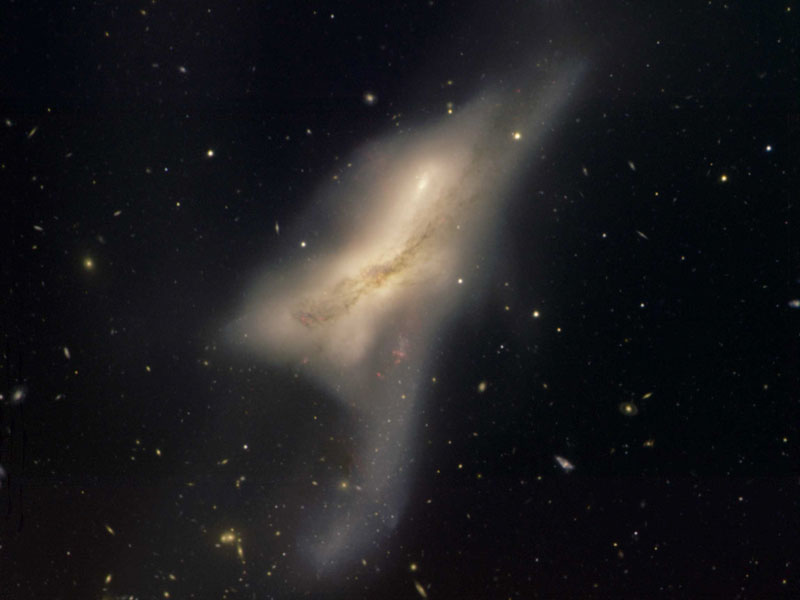
The Colliding Galaxies of NGC 520
Explanation: Is
this one galaxy or two? The jumble of stars, gas, and dust that is
NGC 520 is now thought to incorporate the remains of two separate
galaxies. A combination of observations and simulations indicate
the NGC 520 is actually the collision of two disk galaxies.
Interesting features of NGC 520 include an unfamiliar looking tail
of stars at the image bottom and a perhaps more familiar looking
band of dust running diagonally across the image center. A similar
looking collision might be expected were our disk Milky Way Galaxy
to collide with our large galactic neighbor Andromeda (M31). The
collision that defines NGC 520 started about 300 million years ago
and continues today. Although the speeds of stars are fast, the
distances are so vast that the interacting pair will surely not
change its shape noticeably during our lifetimes. NGC 520, at
visual magnitude 12, has been noted to be one of the brightest
interacting galaxies on the sky, after interacting pairs of
galaxies known as the Antennae. NGC 520 was imaged above in
spectacular fashion by the Gemini Observatory in Hawaii, USA. Also
known as Arp 157, NGC 520 lies about 100 million light years
distant, spans about 100 thousand light years, and can be seen with
a small telescope toward the constellation of the Fish
(Pisces).
Credit &
Copyright: Gemini Obs., AURA, NSF